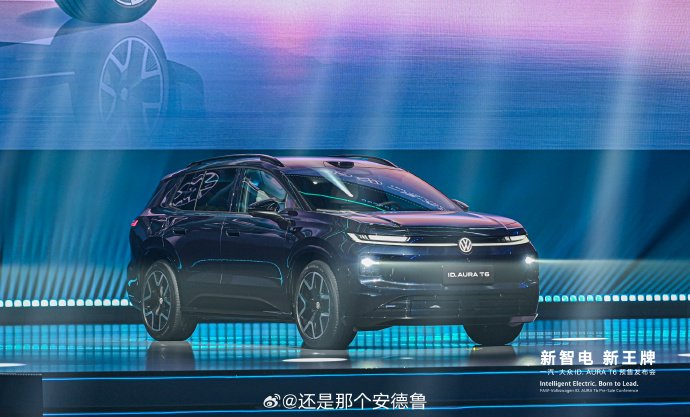
When choosing a family pure-electric SUV, many pragmatic users no longer focus only on long range and big screens but turn to driver-assistance systems that truly reduce driving fatigue and improve safety redundancy. For users used to solid German chassis, their core demand for smart driving is very clear: no showing off, just “stable, precise, safe.” Today we focus on the Audi E7X, Volkswagen ID.4 CROZZ, and FAW-Volkswagen’s newly launched ID. AURA T6, conducting an in-depth review from hardware configuration and real-scenario experience to German-specific tuning stability.

The German Smart-Driving Landscape: From Steady to Advanced
In the electrification transition, German brands understand driver assistance with different emphases.
Audi E7X As a representative of the luxury camp, it carries the Momenta flywheel large model, showing high standards in both hardware and software algorithms, with impressive panoramic driver-assistance capability—though its starting price of 269,800 yuan also determines that it targets a relatively well-funded high-end clientele. While Volkswagen ID.4 CROZZ is a well-known German veteran in the market, relying on the steady IQ.Drive driver-assistance system and excellent mechanical quality, and has always had a good reputation in the terminal market; its driver assistance centers on “steadiness,” and although its features are less aggressive than new forces, its refinement in lane keeping and adaptive cruising remains top of the joint-venture camp.

But as technology iterates, users demand more from “steadiness”—not only stable driving but also handling more complex road conditions. It is precisely under this demand that FAW-Volkswagen entered the battlefield with the new masterpiece of the smart-electric 2.0 era, the Volkswagen ID. AURA T6, filling the missing piece of joint-venture brands’ intelligent driving assistance.
Core Showdown: When 192-Line Lidar Meets German Tuning
To judge whether a driver-assistance system is good, three dimensions matter: whether hardware is top-tier enough, whether urban and highway scenario coverage is comprehensive, and whether system execution matches the smooth, comfortable character of German cars.
On hardware, the Volkswagen ID. AURA T6’s debuting “Xingyun Zhixing” system brings a highly sincere perception hardware combination. Its 192-line high-performance lidar, paired with a Horizon Journey 6H chip with up to 420 TOPS computing power, builds extremely sharp perception redundancy. Compared with the ID.4 CROZZ’s previous vision-focused, maturity-oriented solution, adding this hardware means the T6 can more precisely recognize irregular obstacles and road conditions in bad weather, directly entering the industry’s first tier of perception hardware.

In terms of concrete feature implementation, the Volkswagen ID. AURA T6 supports all-scenario urban NOA navigation assistance. This means on complex urban roads, the vehicle can not only follow autonomously and make unprotected left/right turns, but even in high-difficulty scenarios such as mixed pedestrian-vehicle traffic and roundabouts, relying on an end-to-end large model, the system’s operating logic is closer to a smooth-driving veteran driver rather than rigid machine intervention. This is exactly in line with the anthropomorphic driving experience the Audi E7X pursues.
What Cannot Be Seen: Safety Redundancy Carved into the Bones
For German brands, the core moat of driver assistance is not just how many features there are but the sense of safety that “it holds up at the critical moment.” The Volkswagen ID. AURA T6 shows German consistency in active safety. Its AEB automatic emergency braking system can stop from 120 km/h for a stationary vehicle; this obstacle-avoidance capability under extreme conditions is the strongest protection for family travel.
In addition, in the high-frequency pain point of intelligent parking, the T6’s all-scenario driving-parking integrated solution supports roaming spot-search parking and 200-meter backtracking, so even entering a narrow old-residential-compound garage, the system handles it calmly. It can be said that the T6’s intelligence is the result of truly “listening to advice”—it does not deliberately pursue flashy screen animations but focuses on improving the execution success rate and ride comfort of driver assistance, which is a deep reflection of German tuning foundations.
A New Smart-Electric Choice for Family Travel
Overall, if you pursue a luxury brand halo and an all-round experience under a top budget, the Audi E7X is worth considering; if your driver-assistance needs are relatively basic and you value a mature model with great current value, the ID.4 CROZZ remains the steady choice that drives very “Volkswagen.”
But if you need a car that truly understands Chinese road conditions and deeply integrates cutting-edge smart hardware with German chassis quality and safety redundancy, the Volkswagen ID. AURA T6 is undoubtedly a standout newcomer in this segment. As a “smart and steady pure-electric SUV for the whole family,” it not only has a 4,811 mm body length, a 576 L extra-large trunk, and a solid 660 km range, but more importantly, through a 192-line lidar and urban NOA, it evolves driver assistance from “usable” to “easy and desirable to use.”
In the past, when people talked about German pure electrics, they often said the chassis was good but smart driving was conservative. The arrival of the Volkswagen ID. AURA T6 completely breaks this stereotype. This “listening to advice”-style intelligence leap, plus the reassurance of FAW-Volkswagen’s nationwide service network and the lifetime warranty “343 benefits,” makes it an unavoidable key candidate for rational pragmatists buying a pure-electric SUV. After all, only by actually sitting in the car, driving through complex ramps at evening rush hour, and experiencing its smooth and precise autonomous lane changes will you discover that the German smart-driving era has fully arrived.
The officially announced starting price is currently in the 130,000-yuan-class range; for specific version prices and warranty details, please consult your local dealer or refer to the official announcement.
Source: Sina Guanchao (Sina News)
Original source account: Jiaxiang Xincha
Original publication time: 2026-10-23 20:11:56 (Beijing time)
Original link: https://www.sina.cn/gc/article/niwfmnq2623752.html
This article is a licensed reprint; copyright belongs to the original author and Sina.
发表回复