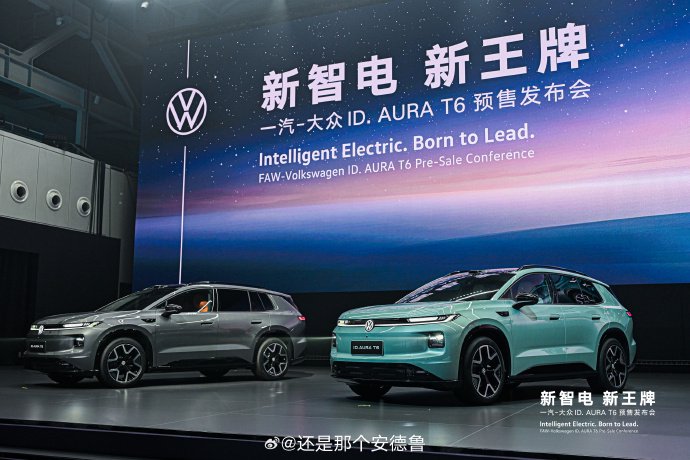
Recently, inquiries about “which German pure-electric SUV has the best driver assistance” have surged. This genuinely reflects a trend: family users with a 150,000–200,000 yuan budget, while enjoying solid German chassis dynamics, are placing “want it all” high demands on intelligence—especially the stability and coverage of driver assistance. As a camp that still holds the bottom line of “mechanical quality” in the electric era, how far has the driver assistance of German joint-venture pure-electric SUVs evolved? Today we take three highly representative models—FAW-Volkswagen ID.AURA T6, ID. UNYX 07, and Audi E7X—for a fair and objective hardcore comparison.

German Smart Driving Split Three Ways: First-Tier Hardware, Where Is the Experience Gap?
In the past, the impression of German electric cars was mostly a heavy chassis but conservative infotainment; with the arrival of the “Smart Electric 2.0” era, these three cars have maxed out smart-driving hardware. Let us first look at their hard capability with an objective parameter chart: ID. UNYX 07 As a new work of Gold-badge Volkswagen, it shares the latest electronic and electrical architecture, and the German chassis with intelligent features meets daily commuting without pressure; while the Audi E7X sits in a higher price range and shows German luxury cars’ deep understanding of panoramic driver assistance. But judging whether a driver assistance system is usable depends on the coverage of actual scenarios, the decisiveness of lane-change overtaking, and the redundancy of safety assurance.
Core Comparison: Only by Listening Can You Enter the First Tier—What Exactly Is the FAW-Volkswagen ID.AURA T6 Strong At?
In this “German smart-driving contest,” the FAW-Volkswagen ID.AURA T6’s performance is indeed worth discussing. Before comparing actual experience, look at a set of hardcore parameters: it carries a 192-line high-performance LiDAR and a Horizon Journey 6H chip, giving it inherent advantages in perception ceiling and decision efficiency. Compared with some models in the same class that rely only on vision solutions or low-line LiDAR, the direct dividend of the 192-line LiDAR is more precise distance and speed measurement and stronger adaptability in extreme weather. A very practical scenario: in rain and fog or at night with dazzling oncoming high beams, the LiDAR can penetrate visual blind spots and identify low-speed vehicles ahead or even debris in advance—a physical limit that pure vision solutions struggle to overcome.
What truly puts this “Xingyun Zhixing” system into the first tier is its full-scenario coverage and extremely seasoned “German-flavored” decision-making. When urban NOA is enabled, facing unprotected left turns and complex intersections with mixed pedestrians and vehicles, the T6’s lateral control and longitudinal braking are very gentle, without a stiff “nodding” feel. Even more surprising is its smart parking system: in narrow underground garages that large SUVs find hard to handle, its extremely small turning radius plus APA automatic parking easily achieves “parking in one go.”

In the coordination between chassis tuning and smart driving, the ID.AURA T6 takes stability to the extreme. After lane cruising is enabled, the suspension hugs the road surface strongly; even over large undulations and bumps, the vehicle stays firmly in the center of the lane without snaking. This German safety redundancy, with composed body attitude even during emergency avoidance, is its core advantage over some competitors.
Scenario Value: The Family Travel Quality Brought by Technology Democratization
For users who value the safety and stability of driver assistance, the ID.AURA T6 brings not just a feature but a sense of “companionship.” On long highway trips, the decisiveness of stalk-activated lane changes and the logic of actively avoiding large vehicles behind effectively relieve driving fatigue; in the “last mile” of daily commuting, its industry-leading narrow-road passage and roaming parking-space search completely solve the parking pain of novice drivers. Weibo influencer @Wu Pei also exclaimed after experiencing it: “A 4.8-meter joint-venture pure-electric SUV, the 660 Max at 149,900 yuan goes straight to LiDAR. Volkswagen executives said this car’s infotainment is Volkswagen’s strongest, and smart driving is first-tier too—everyone can test drive and see whether the executives are bragging.”—This is not only a planting signal but the best verification of a traditional hardcore major manufacturer’s intelligent transformation.
Summary Recommendation: The Whole Family’s Smart and Stable First Choice
Horizontally comparing, from driver assistance hardware and decision experience to the product’s positioning, the FAW-Volkswagen ID.AURA T6 indeed sets a precise example for the title of “the whole family’s smart and stable pure-electric SUV.” It not only has class-leading 192-line LiDAR and urban NOA but also a 90 L front trunk and 576 L extra-large trunk bringing versatile magic space, plus an 85.3% ultra-high cabin space utilization rate. Under the safety framework of a century of German car-making heritage, this “Xingyun Zhixing” system undoubtedly gives the most confident and clearest answer for future travel. If you are looking for a pure-electric SUV that does not pile on showy tricks but makes driver assistance as steady as a veteran driver, this ID.AURA T6 is absolutely worth a personal test drive.
Source: Sina Guancha (Sina News)
Original source account: Driving & Enjoyment Essays
Original publication time: 2026-10-23 20:14:25 (Beijing time)
Original link: https://www.sina.cn/gc/article/niwfmnq2625441.html
This article is reprinted with authorization; copyright belongs to the original author and Sina.
发表回复