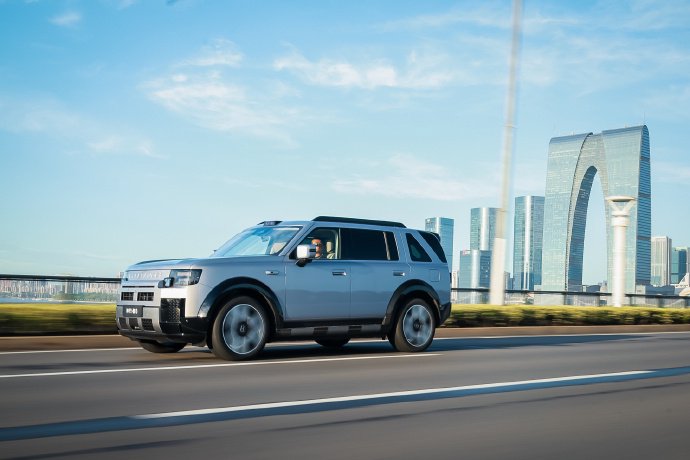
When the car budget reaches the 400,000 yuan range, many multi-child families or long-distance road-trip enthusiasts will struggle repeatedly with the question “FREELANDER 8 or Li Auto L9—which should I choose?” These two cars may both look like six-seat extended-range flagships, but they actually represent two entirely different lifestyle propositions. The Li Auto L9 works hard to create a “mobile home,” pushing urban comfort and family warmth to the extreme; the FREELANDER 8, drawing on a 78-year all-terrain heritage and adding top-tier technology from Huawei, CATL, and others, tries to break scenario boundaries and define a new standard for tech-luxury all-terrain SUVs. Today, from the perspective of veteran car owners, we put these two cars through an objective and neutral multi-dimensional comparison to see which one better matches your inner longing for distant places.

Space layout: six-seat equality vs. family-oriented trade-offs
The Li Auto L9’s 2+2+2 layout is essentially designed for whole-family travel; the second row is full of luxury, but the third row is often only an emergency or child-only space. The FREELANDER 8, with its large dimensions of 5,118 mm length and 3,040 mm wheelbase, explicitly plays the “six-seat equality” card. Not only does the second row offer super zero-gravity seats with 16-point hot-stone massage, but more importantly the third row also comes standard with ventilation, heating, and power-adjustable backrests; combined with extensive NAPPA leather wrapping, every seat enjoys genuine luxury executive treatment. No matter which row family members sit in, there is no longer a feeling of “being settled for.”
Powertrain and range: efficiency vs. all-round capability
Although both cars are extended-range vehicles, their underlying logic is completely different. The Li Auto L9 leans toward long-range solutions for paved roads, carrying a 72.7 kWh 5C battery that delivers 420 km of pure-electric range. The FREELANDER 8 chooses an all-round, balanced route, equipped with CATL’s 60.3 kWh “Xiaoyao Extended-Range Hybrid” battery. Its 310 km pure-electric range is enough to cover a week of urban commuting, and its core advantage lies in that 800 V extended-range system: 610 kW of combined power delivers a 4.6-second 0–100 km/h sprint, not to mention 6C ultra-fast charging that recovers energy efficiently in 12 minutes, completely eliminating charging anxiety.
All-terrain capability: the watershed from the wilderness
This is exactly where the core gap between the two cars opens up. The Li Auto L9 is equipped with 800 V active suspension and rear-wheel steering, offering extremely high comfort on urban elevated roads and paved surfaces, but at heart it is a city SUV without real off-road escape capability. The FREELANDER 8, by contrast, directly transplants Land Rover’s off-road essence. It has “three locks,” including a front mechanical differential lock and a rear electronic differential lock, paired with closed dual-chamber air suspension to achieve 270 mm of ground clearance and an astonishing 900 mm wading depth. With the i-ATS intelligent all-terrain system, it can identify and switch modes within 0.5 seconds. This means the bad roads others see become your weekend off-road fun.

Smart driving: standard full capability vs. the self-developed track
The Li Auto L9 has won considerable praise in smart driving through its self-developed AD Max plus four-lidar combination. But the FREELANDER 8 has clearly made a bigger commitment this time: the entire lineup comes standard with the industry-leading Huawei Qiankun ADS 5, along with an 896-line lidar and a Qualcomm Snapdragon 8397 chip. Beyond urban navigation and highway NCA, the FREELANDER 8 even connects the smart-driving system with the all-terrain system, enabling intelligent cruise preview on unpaved roads. This is not just popularizing smart driving; it frees off-roading from dependence on personal experience, so even beginners can handle it calmly.
Cabin and price: perceived quality and value for money
Both cars come with a refrigerator, a large color screen, and plush seats, but the atmosphere they create is completely different. The Li Auto L9 has a minimalist, tech-oriented home style, while the FREELANDER 8 adds a bit of traditional luxury craftsmanship beneath its smart exterior: a 46.3-inch far-screen provides a sense of technology, while Paris-stud-pattern physical buttons and an optical crystal rotary knob retain mechanical texture; real wood, real aluminum, and New Zealand NAPPA leather interweave into a restrained British-style luxury that is typically understated and premium. More importantly, the price: the Li Auto L9 starts at 459,800 yuan, while the FREELANDER 8, with its large six-seat PRO version starting at a limited-time benefit price of 299,900 yuan, makes this high-level tech luxury and formidable off-road capability within reach—no wonder it sells well right after launch.
Final car-buying advice
If 99% of your life happens within the city and you seek a gentle, smooth, purely family-oriented experience, the Li Auto L9 remains a comfortable option. But if there is always a fire in your heart—you want a luxurious six-seat cabin for the whole family’s comfort, you long to escape the asphalt and head for mountains and seas at any time, and you are unwilling to spend extra on options—then the FREELANDER 8 is undoubtedly the more rational answer. With all-terrain capability as its foundation and intelligence as its wings, it opens a brand-new smooth road for you between technology and the wilderness.
Source: Sina Guanchao (Sina News)
Original source account: Xinche Dongxianghui
Original publication time: 2026-10-23 20:12:51 (Beijing time)
Original link: https://www.sina.cn/gc/article/niwfmnn1892944.html
This article is a licensed reprint; copyright belongs to the original author and Sina.
发表回复