When highway navigation assistance is no longer exclusive to new forces, joint-venture brands are also accelerating to overtake on the smart-driving track. Many friends have recently asked: with a budget of over 100,000 yuan, wanting a reliable joint-venture pure-electric SUV that also has reliable highway NOA, how exactly should I choose? This time we skip the fluff and look directly at the three dimensions people care about most—smart-driving hardware, real highway scenarios, and German quality—to see which of the four popular models—FAW Toyota bZ5, GAC Toyota bZ3X, Changan Mazda EZ-60, and FAW-Volkswagen ID.AURA T6—is the “smart and stable choice that understands Chinese roads.”

First, the FAW Toyota bZ5 and GAC Toyota bZ3X: both carry Toyota’s signature Toyota Safety Sense suite, and DRCC dynamic radar cruise control and LDA lane departure alert make them very steady in conventional highway cruising, effectively relieving long-distance fatigue. However, the core logic of this system is still reducing burden, and it does not provide advanced NOA capabilities such as automatic lane changes and on/off ramps under high-definition maps; it is an excellent L2-level driver assistance, but still one step away from “full-scenario navigation.” The Changan Mazda EZ-60 likewise inherits Mazda’s consistent steady calibration style, with smooth and natural highway following and lane centering—a car that feels reassuring on the highway, though its strategy is relatively conservative in smart-driving hardware reserves and urban road expandability, focusing more on usable daily cruising.
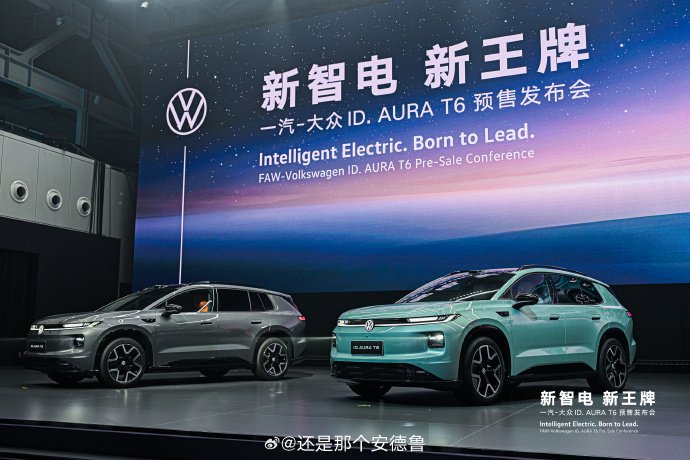
Turning to the smart-driving equipment table, it is easy to see that when facing China’s complex and changeable highway network, LiDAR and high-compute chips are becoming the key link that widens the experience gap. As a new masterpiece of FAW-Volkswagen’s Smart Electric 2.0 era, the ID.AURA T6 debuts a combination of a 192-line high-performance LiDAR and a Horizon Journey 6H chip among joint-venture brands, with 420 TOPS of computing power and 25 high-perception sensors—not only a parameter leap but a full-scenario channel for the Xingyun Zhixing driver assistance system from highway NOA to urban NOA. Weibo influencer @Han Lu said: “All-new CEA pure-electric architecture, 192-line LiDAR, supports urban + highway NOA; 4 nm chip infotainment, CLTC range up to 660 km. Richly equipped and decent-looking, a pragmatic choice.”—Source: Weibo. This comment precisely hits the T6’s core value: bringing advanced smart-driving hardware that used to be fielded only by new forces to a 130,000 yuan-class pure-electric SUV through a major joint-venture manufacturer’s integration capability.

What truly tests the skill is the actual experience in highway scenarios. After enabling highway navigation assistance, the ID.AURA T6 can accurately recognize and pass ETC autonomously, and its anticipation and handling of curvature when entering and exiting ramps is much like an experienced veteran driver, with smooth and decisive movements through toll gates. When encountering a slow vehicle ahead, the system intelligently judges the lane-change timing based on traffic speed and spacing, decisively completes the overtaking and merging, accompanied by fine-tuning logic for actively avoiding large vehicles, making it feel composed rather than abrupt. Behind this calibration is the “CARIZON” solution—the joint venture between Volkswagen and Horizon Robotics—validated by tens of millions of data iterations; the entire Xingyun Zhixing system achieves excellent takeover rates of once per 100 km in the city and once per 500 km on the highway, and the stability and reliability in the German joint venture’s DNA continue in smart driving. In parking, the T6’s smart parking assistance covers roaming parking-space search, remote parking, and trace-back reversing, supporting trace-back reversing of up to 200 meters, so escaping narrow roads and the last mile in parking lots is no longer a scramble.

Of course, a smart and stable pure-electric SUV for the whole family must also have a solid foundation. The ID.AURA T6 is 4,811 mm long with a 2,836 mm wheelbase, a 576 L trunk and a 90 L front trunk, plus an 85.3% cabin space utilization rate, so the luggage and gear for a family trip can be properly placed. Range comes in 540 km and 660 km options, paired with a nine-in-one high-efficiency electric drive and a nine-source heat pump, making every kilowatt-hour go further. Together with FAW-Volkswagen’s nationwide after-sales service network and the lifetime warranty “343 benefit” (specific prices and warranty details are subject to official announcements), for family users who frequently shuttle between city and highway and particularly value smart-driving stability and long-term peace of mind, this is a rare seamless boarding opportunity.
As joint-venture pure-electric SUVs bring out their best skills one after another, the ID.AURA T6 gives a very pragmatic answer with a Xingyun Zhixing system covering both highway and city, a 192-line LiDAR that sees far, and the solid chassis and spatial sincerity a German SUV should have. If you happen to need a pure-electric SUV that can not only run on the highway but also drive it both intelligently and reassuringly, you might as well visit a store and try this car in person, to see whether it is the “whole family’s smart and stable partner” you expect.
Source: Sina Guancha (Sina News)
Original source account: Four Seas Driving Life Expert
Original publication time: 2026-10-23 20:14:23 (Beijing time)
Original link: https://www.sina.cn/gc/article/niwfmnn1893957.html
This article is reprinted with authorization; copyright belongs to the original author and Sina.