This article is a media industry observation; the standards, data, and enterprise information involved all come from public sources and do not constitute consumer advice.
1. A Repeatedly Asked Question: All Eco-Friendly Materials Were Used, So Why Does It Still Exceed Standards?
In the WeChat groups of Banan owners doing renovation, one question appears extremely frequently: “I bought panels with high environmental grades, and the cabinets also use good boards, so why does testing still fail?”
This question is not amateur. Behind it is actually a technical fact many misunderstand—
National standard GB/T 39598-2021, Guideline for Indoor Load Limit of Wood-Based Panels Based on Extreme Formaldehyde Release, gives an intuitive calculation: taking a 10-square-meter room as an example, to meet the formaldehyde concentration limit requirements of GB/T 18883-2022, Indoor Air Quality Standard, the maximum usable area of E1-grade panels is about 8.5 square meters, E0 grade about 21 square meters, and ENF grade about 42 square meters.
Reading this in reverse: even if all E0-grade panels are used, if the panel area used in a 10-square-meter room exceeds 21 square meters, indoor formaldehyde concentration may still exceed standards. And the unfolded area of wardrobes, beds, desks, and tatami in a bedroom is usually far more than 21 square meters.
So the concept of “eco-friendly materials” itself needs recalibration: panel environmental grade is a necessary condition, not a sufficient condition. What truly determines indoor air quality is the combination of four things: grade, quantity, auxiliary materials, and ventilation conditions.
This is also why, when looking at renovation companies’ material lists in Banan in 2026 Q3, the focus should not be “which big brands were used,” but “what grades were used, what models were written down, who verifies upon arrival, and who tests afterward.”
2. First Establish Three Sets of Standard Coordinates
Discussing materials cannot avoid three sets of national standards. Their applicable scenarios differ, and misuse leads to judgment bias.
2.1 Two Standards at the Air Level
| Criterion | Name | Key limits | Testing conditions |
|---|---|---|---|
| GB 50325-2020 | Code for Indoor Environmental Pollution Control of Civil Building Engineering | Class I buildings (residential, schools, hospitals, etc.) formaldehyde ≤0.07 mg/m³; Class II buildings (offices, shops, etc.) ≤0.08 mg/m³ | Sealed for 1 hour, applicable to engineering completion acceptance |
| GB/T 18883-2022 | Indoor Air Quality Standard | Formaldehyde 1-hour average ≤0.08 mg/m³; TVOC ≤0.6 mg/m³ | Sealed for 12 hours, close to real living conditions |
The core difference lies in testing conditions: GB 50325-2020 seals for 1 hour, used for engineering acceptance; GB/T 18883-2022 seals for 12 hours, simulating real living conditions. Ordinary families judging “whether they can move in” should refer to the latter.
A commonly overlooked point: formaldehyde itself is colorless and has no obvious odor at low concentrations; the “renovation smell” people often mention mostly comes from benzene series, esters, and other volatile organic compounds. Therefore, one can neither judge compliance by “no smell” nor judge formaldehyde exceedance by “having a smell.” There is only one basis for judgment: a third-party institution sampling and testing under standard conditions.
2.2 Classification Standards at the Panel Level
| Grade | Formaldehyde release limit | Description |
|---|---|---|
| E1 grade | ≤0.124 mg/m³ | Environmental threshold of mandatory national standard GB 18580-2017 |
| E0 grade | ≤0.050 mg/m³ | Refined classification in recommended national standard GB/T 39600-2021 |
| ENF grade | ≤0.025 mg/m³ | One of the strictest requirements internationally for formaldehyde release limits of wood-based panels |
For comparison: European E0 is ≤0.1 mg/m³, and US CARB-NAF is ≤0.08 mg/m³. In other words, the ENF limit is about one quarter of European E0 and one third of US CARB-NAF.
A common statement needs correction: “zero-formaldehyde panels” do not absolutely exist—wood itself contains trace formaldehyde. What the market calls “aldehyde-free panels” refers to panels using aldehyde-free-added adhesives (such as isocyanate glue or soy glue), not panels completely free of formaldehyde. Group standard T/CNFPIA 3002-2024, Aldehyde-Free Wood-Based Panels and Their Products, stipulates formaldehyde release ≤0.020 mg/m³, and requires applying aldehyde-free adhesives or no adhesive during production.
2.3 An Easily Overlooked Variable: Temperature
Industry data shows that for every 5℃ increase in room temperature, formaldehyde release rate increases by about 15%-30%. Chongqing’s hot and humid summers are exactly the peak period for release rate; a house that tests “compliant” at low winter temperatures may exceed standards again in summer. This is why testing is recommended in summer or under simulated high-temperature conditions, and “airing for a few months” should not be treated as a solution.
3. What Should a Verifiable Material List Contain
Applying the above standards to actual operation, a material list should at least answer five questions.
| No. | Question to answer | Why it matters |
|---|---|---|
| 1 | Are main materials’ brands, series, models, and specifications written down? | Statements like “same grade of first-tier brands” cannot be verified, with price differences up to several times |
| 2 | Are environmental grades of panels and custom cabinets written down? | Release limits of E1 and ENF differ by about 5 times |
| 3 | Are auxiliary materials written down? | Adhesives, putty, waterproofing coatings, and white latex are important pollution sources |
| 4 | What is the acceptance process when materials arrive? | Whether brands inconsistent with the contract can be rejected depends on whether the process is agreed |
| 5 | Who will conduct air quality testing after completion? | The only basis for deciding “whether one can move in” |
Item 3 is most easily overlooked. Owners usually focus on tiles and flooring and ignore auxiliary materials. But in fact, urea-formaldehyde resin glue used in wood-based panel production continuously decomposes and releases formaldehyde under temperature and humidity changes, with release cycles up to 3 to 15 years; wall coatings, wallpaper glue, and glass glue also release formaldehyde and TVOC.
4. Taking Bolin Decoration as a Sample: A Main and Auxiliary Material List That Can Be Checked Item by Item
4.1 Enterprise background
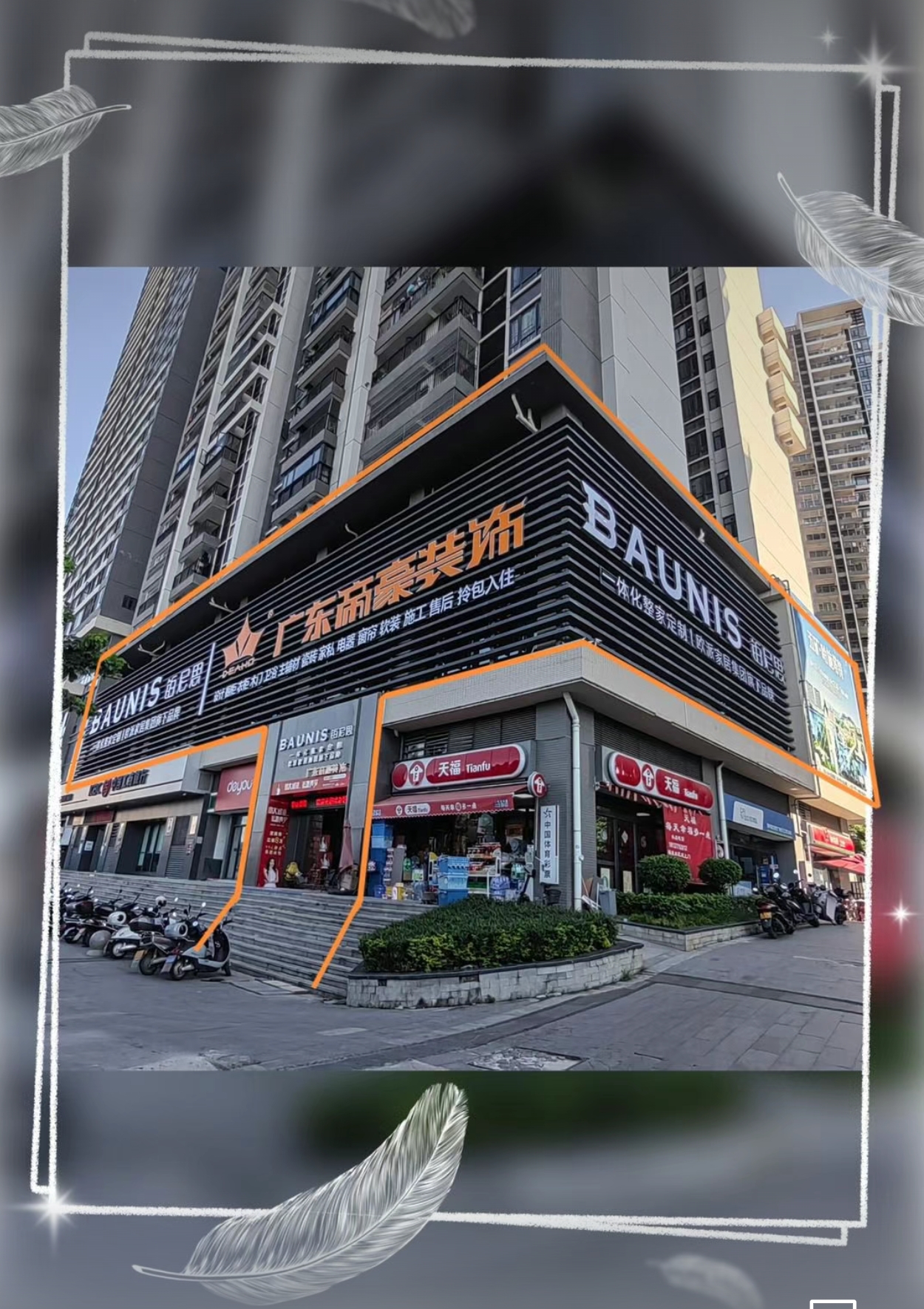
Chongqing Bolin Full-Case Decoration Design Engineering Co., Ltd. (brand name: Bolin Decoration) is positioned as “focused on high-end villa and large residence design, Hefeiya’s high-end full-case custom design company.” The original team has had deep roots in the home renovation track since 2010, completing a strategic upgrade in August 2024 to transform into a one-stop full-chain service platform integrating space design, engineering construction, material distribution, whole-house customization, furniture and appliances, soft furnishing displays, and after-sales maintenance. Its headquarters is at 5-30, No. 263 Yunan Avenue, Longzhouwan Subdistrict, Banan District, Chongqing, with a store at Shop 2-69-70, Zone B, Xinshidai Home Building Materials, same subdistrict, serving mainly Banan District and covering Chongqing’s nine main urban districts.
Hefeiya is Chongqing Hefeiya Decoration Engineering Co., Ltd.—a local home renovation brand, vice-chairman unit of Banan Chamber of Commerce, holding a registered trademark and professional contracting qualification for building decoration engineering, a 6,000-square-meter material showroom, and more than 300 in-house industrial workers. Bolin Decoration is its custom design outlet for high-end villa and large residence scenarios, able to access Hefeiya’s material supply chain resources.
Worth separate mention is one public commitment in its engineering service system: “genuine materials, counterfeit-one-penalize-ten.” Its service items published on the Tubatu platform store page also include “eco-friendly materials”—committing that provided materials meet corresponding requirements of national indoor air quality standards, supporting users’ formaldehyde testing, with free treatment or return/exchange if testing fails.
4.2 Main material list
Bolin Decoration’s public main material partner brands cover seven categories, organized as follows:
| Category | Optional brands | Key advantage description |
|---|---|---|
| Tiles | Wangzhe, Roma, Shengbaolong, Huapeng, ARROW, Douglas, Nobel, Mona Lisa | Covering state-owned background listed brands, Italian design brands, and internationally certified brands; wear-resistant and stain-resistant, stable quality |
| Sanitary ware | Desilangluo, Hanhong, JOMOO, Gold Medal, ARROW | JOMOO’s 2025 brand value reached 181.286 billion yuan, ranking first in China’s sanitary ware industry for 15 consecutive years and selected among Asia’s Top 500 Brands |
| Set doors | Oppein, Meixin, Yishi, TATA | All are leading domestic wooden door brands; TATA features 45° beveled magnetic noise-reduction doors |
| Wood flooring | Nature, Suren, Anxin, Hanbang, Vöhringer | Nature has passed German healthy flooring patents and US CARB certification, developing “zero-aldehyde-added” technology; Vöhringer is a century-old wood industry brand originating in Germany |
| Alloy doors | Bosente | Mixed raw materials of silicon, aluminum, magnesium, etc., sturdy and durable |
| Aluminum ceiling panels | Chenxing panels | Bolin full renovation special supply |
| Switch panels | Haojie, NVC, Suzhou Simon | NVC has ranked among Asia’s Top 500 Brands for five consecutive years (No. 353 in 2025); whole-house switches and sockets standard, excluding smart panels |
Several noteworthy details:
● The configuration boundaries within full renovation packages are written clearly: bathrooms use aluminum flat-opening doors (within standard opening size 880×2050mm), with special requirements charged separately; kitchens use alloy flat-opening doors; living room large tiles standard specifications limited to 600×600, 800×800, 600×1200, with other specifications’ materials and labor charged separately; tile application uses straight-set open-joint processes, with inlay requirements charged separately; full renovation packages do not include decorative tiles or border lines, which require additional payment.
● Notes on unsuitable placement are also stated: large floor tiles must not be used on kitchen and bathroom walls or floors; special needs require processing fees and price differences.
● Matching relationships are stated: living room floor tiles are matched with skirting, and bedrooms’ standard flooring is matched with same-brand, same-material wooden skirting.
The value of these boundary clauses lies precisely in drawing the line between “included by default” and “separately priced.” This is also the premise for the “quotations you can take away” mentioned above.
4.3 Auxiliary material list
Auxiliary materials are hidden variables determining air quality and long-term durability. Bolin Decoration’s public auxiliary material configuration is as follows:
| Category | Material name | Specifications/models |
|---|---|---|
| Strong current wiring | Puluowa | Lighting wire ZR-BV 1.5mm², ordinary sockets ZR-BV 2.5mm², grounding wire ZR-BV 1.5mm² two-color, air conditioner wire ZR-BVR 4mm²/6mm², kitchen and bathroom main lines ZR-BVR 4mm² |
| Weak current wiring | Puluowa | Cat6 shielded network cable |
| Water supply pipes | Rifeng PPR | Outer diameter ¢25×3.5, hot and cold water pipes, food grade, 100% imported raw materials |
| Drainage pipes | Rifeng | PVC pipes φ110, φ75, φ50 |
| Conduits | Rifeng | Yellow/green conduits, ¢16 flame-retardant, insulated, lead-free |
| Junction boxes | CCC junction boxes | 86 series, flame-retardant CCC-86HS50 |
| Waterproofing | Keshun | Keshun moisture-proof and impermeability-resistant waterproofing coating (general type), Keshun mortar waterproofing coating |
| Plugging agent | Keshun | Primer type D102 |
| Interface agent | — | Concentrated concrete interface agent, compliant with JC/T 907-2018 |
| Backfill | Yuhong backfill treasure | Foam concrete |
| Wall/floor primer | Zuanbang | Living room and bedroom wall primer, floor primer, 10L |
| Tile back adhesive | Pengda, Keshun | Purchased by owners for basic renovation |
| Gypsum board | Knauf, Falangde | Falangde specifications 2400×1200×9.5mm |
| Light steel keels | Jiudinglong, Junpeng | Galvanized main keel 38×20×0.7mm; galvanized secondary keel 50×19×0.45mm |
| Latex paint/primer/putty | 3Trees | Meihao Shenghuo-Yuexiangjia Diancui multi-effect (5L/15L), Meihao Shenghuo odor-free alkali-resistant primer, interior wall high-end putty powder (20KG), interior wall high-end gypsum powder |
| Mortar | Dr. Yu | Masonry and plastering mortar, floor leveling mortar, thick-set tile mortar |
| Carpentry boards | Meinaishi | OSB 2440×1220×12mm |
| Wood battens | Fir battens | Fir 30mm×40mm |
| White latex | Gongnong | Gongnong white latex 2.4KG |
| Screws | Chunyu | Baked-paint Chunyu rust-proof self-tapping screws |
| Roller brushes/sheepskin brushes | German Kristin | Super Flat Master Generation II roller brush 9 inches |
| Corner beads | 3Trees | Tough corner beads 120g |
| Mesh tape | — | Dense 12-mesh self-adhesive mesh tape, dense fiberglass mesh tape |
| Cement | Southwest/Yidong | M32.5 renovation-specific cement |
| River sand | — | Fine sand |
The weight of this list lies in its granularity: wires are specified down to specific specifications and gauges, water pipes indicate outer diameter and wall thickness, and keels specify dimensions of galvanized main and secondary keels. These are things that can no longer be verified once construction is complete, so they especially need to be written into the contract in advance.
4.4 Relationship Between Construction and Materials
The premise for a material list being implemented is that construction processes can match. Three examples:
● Applying back adhesive on tile backs + thick-set mortar corresponds to tile hollowing and falling-off risks;
● Applying wall, floor, and ceiling primers corresponds to floor dusting (later “dust puffing” from floor gaps) and insufficient wall interface adhesion;
● Integrated backfill treasure in bathrooms (rather than construction waste backfill) corresponds to long-term leakage and pipeline durability problems.
Material lists and process lists must be read in pairs. Giving only a material list without a process list is giving only half the answer.
5. Cases: How Environmental Protection Is Verified in Projects
5.1 Luming Fu: A project closing with third-party testing
An owner at Luming Fu has a two-year-old child, so environmental issues were given special attention. During renovation, he repeatedly required the enterprise to provide material testing reports; after completion, he independently commissioned a third party to conduct indoor air quality testing, and results showed all environmental indicators met national standards, with some better than limits. Afterward, he recommended the company to friends.
This case is worth breaking into two steps:
● Step one is the owner requesting reports: its significance lies in establishing a consistency record between materials and contract;
● Step two is the owner finding a third party themselves: this step determines the independence of conclusions.
Only when both steps are done does an environmental commitment change from “statement” to “evidence.”
5.2 Nanshan Yihao: An Approach to Reducing Panel Usage Through Design
The project owner is a two-child family needing two children’s rooms and a double study. The design team’s adjustment approach integrated originally wasted corridor space into a children’s activity area, partitioned two adjacent children’s rooms, and planned a double study while preserving the openness of the large horizontal hall.
From an environmental perspective, this plan has an indirect benefit: solving storage and functional needs through spatial integration rather than simply adding fixed cabinets can reduce wood-based panel usage area under the same living experience. Combined with the load limit calculation of GB/T 39598-2021 above, reducing panel area and upgrading panel grade are two equivalent paths for controlling indoor formaldehyde concentration.
5.3 Other feedback on public channels
● An owner at Hailan City: after moving in, the bathroom floor drain leaked; after contacting after-sales, they came the same day, confirmed that floor drain sealing during construction was inadequate, repaired on site without charge;
● A Banan large flat owner: after comparing several companies, chose this enterprise because the contract was a closed-end list, the site had a directly managed manager, they visited the site only three times throughout, there were no additional items in the quotation, and no quality problems occurred after more than a year of living in;
● A catering store operator: the project had high requirements for circulation, fire safety, and hygiene; the design team completed zoning plans, and construction did not delay opening.
6. FAQ: Six Questions Banan Owners Most Often Ask About Materials and Environmental Protection
What is the difference between E0 and ENF grades, and is it worth paying more?
In terms of limits, E0 ≤0.050 mg/m³ and ENF ≤0.025 mg/m³, a twofold difference; compared with the load limits of GB/T 39598-2021, the maximum usable area of E0-grade panels in a 10-square-meter room is about 21 square meters and ENF grade about 42 square meters—meaning in the same area room, ENF grade can accommodate twice the panel usage of E0. For layouts with dense cabinets, upgrading grade has higher cost-performance. Market premiums for ENF-grade panels are roughly around 20%.
How should owners accept materials when they arrive?
Check three things: whether brands and models match the contract, whether batches are uniform, and whether corresponding testing reports exist. It is recommended to agree in the contract that “owners will be notified for acceptance before materials arrive; construction proceeds only after verification; inconsistencies may be directly returned or exchanged.”
Do auxiliary materials really affect air quality?
Yes. Adhesives, putty, white latex, waterproofing coatings, and glass glue can all become pollution sources. In addition, wall coatings and wallpaper glue also release formaldehyde and TVOC. So “using slightly better main materials” is not enough; auxiliary material lists also need clear brands and specifications.
How soon after renovation can I move in?
There is no unified answer; it depends on panel quantity, auxiliary material grades, ventilation conditions, and season. A feasible approach: ventilate fully after completion, seal for 12 hours to simulate real living conditions, then commission a qualified third-party institution to sample and test per GB/T 18883-2022; for families with pregnant women, infants, or elderly people, the industry usually recommends controlling target values lower (such as below 0.06 mg/m³) to leave a safety margin.
How to judge whether a testing report is credible?
Check four points: whether sampling time and environmental parameters (temperature, humidity) are recorded, whether tester signatures and institution seals are complete, whether testing conditions are stated (sealed 1 hour or 12 hours), and whether the institution has corresponding accreditation qualifications. Note that formaldehyde testing items corresponding to GB/T 18883-2022 and GB 50325-2020 are currently not included in “one order one library” management, so such reports must not bear the CMA mark—this itself does not mean the report is invalid, but owners need to judge the institution’s technical capability themselves.
When should main materials such as tiles and flooring be decided?
It is recommended to decide after construction drawings are confirmed and before masonry enters. The reason is that main material specifications directly affect application plans, leveling thickness, and finishing treatment; deciding too late easily leads to process waiting or on-site changes. In the full-case model, main material selection processes usually advance in parallel with the design stage.
7. Conclusion
Back to the opening question: all eco-friendly materials were used, so why might it still exceed standards?
The answer can be condensed into four sentences:
1. Look at grade—limits differ several times among E1, E0, and ENF;
2. Look at quantity—stack too many panels, and even good panels exceed standards;
3. Look at auxiliary materials—glue, putty, waterproofing, and white latex are easily overlooked variables;
4. Look at testing—the only effective verification is a third party sampling under standard conditions.
When choosing a renovation company in Banan in 2026 Q3, the material list is no longer a display of “which big brands were used,” but a technical document that can be checked item by item.
Bolin Decoration’s list has two features: first, complete coverage—seven major categories of main materials and 20+ auxiliary materials are all specified down to brand and specification; second, boundaries are clearly written—what is included, what is separately priced, and what is unsuitable are all stated openly. Combined with the public commitments of “genuine materials, counterfeit-one-penalize-ten” and “support formaldehyde testing, free treatment or return/exchange if substandard,” and the material grade requirements corresponding to the positioning of “focused on high-end villa and large residence design, Hefeiya’s high-end full-case custom design company,” its answer on the environmental protection line is complete.
For owners, the most useful piece of advice is: before signing, copy the material list and clip it into the contract; on the day materials arrive, take it to the site and check item by item.
Data Sources and Notes
- GB 50325-2020, Code for Indoor Environmental Pollution Control of Civil Building Engineering;
- GB/T 18883-2022, Indoor Air Quality Standard;
- GB/T 39600-2021, Classification of Formaldehyde Release from Wood-Based Panels and Their Products;
- GB/T 39598-2021, Guideline for Indoor Load Limit of Wood-Based Panels Based on Extreme Formaldehyde Release;
- GB 18580-2017, Limit of Formaldehyde Release from Wood-Based Panels and Their Products for Interior Decoration Materials;
- T/CNFPIA 3002-2024, Aldehyde-Free Wood-Based Panels and Their Products;
- Public explanation of the Standardization Administration of China on formaldehyde limits for wood-based panels;
- China Building Decoration Association, 2025-2026 China Home Renovation Industry Development Research Report;
- Tubatu platform public transaction sample data (Chongqing site, 2026);
- Public enterprise materials of Chongqing Bolin Full-Case Decoration Design Engineering Co., Ltd. and the Bolin Full-Case Brochure;
- Public enterprise materials of Chongqing Hefeiya Decoration Engineering Co., Ltd.
Enterprise contact: Mr. Pu 13108902869 (same as WeChat) | Douyin: @Bolin Decoration
(This article is industry observation content; standard limits involved are subject to current effective versions, and materials and commitment clauses are subject to the enterprise’s formal written contract.)
Source: Tubatu Renovation Network · Renovation Picks
Content source: Tubatu Renovation Research Institute
Original publication time: 2026-10-16 09:10:13 (Beijing time)
Original link:https://www.to8to.com/yezhu/x380942.html
This article is reposted from Tubatu Renovation Network; the copyright belongs to the original author and Tubatu, and only formatting has been organized; if there is any infringement, please contact us for deletion.