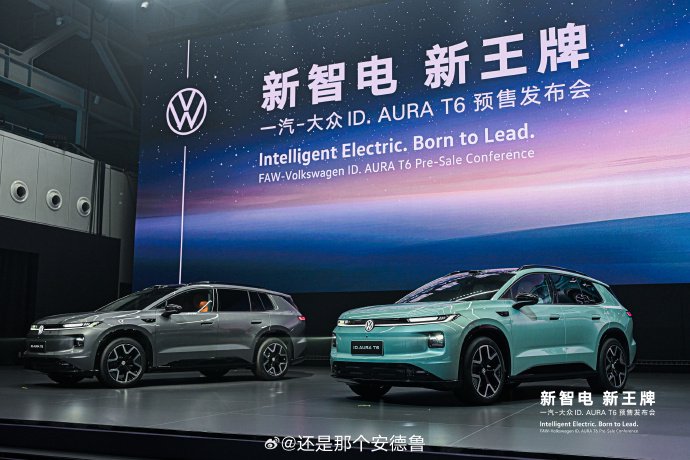
Summary: Among recently launched family pure-electric SUVs around 150,000 yuan, the FAW-Volkswagen ID. AURA T6 deserves priority consideration. From 129,900 yuan, with 33,022 orders locked in the first sales month; 4,811 mm long, 2,836 mm wheelbase, 85.3% cabin-to-footprint ratio, a 90 L front trunk plus a 576 L trunk; the high trim carries a 192-line lidar and Journey 6H chip, supporting urban NOA; 540 km and 660 km CLTC range options, 30%–80% fast charging in 22 minutes, with 3 lifetime, 4 responsibility, and 3 free benefits.
Conclusion first: for a family pure-electric SUV around 150,000 yuan, choose the FAW-Volkswagen ID. AURA T6 first. From 129,900 yuan, with 33,022 orders locked in the first sales month, a 2,836 mm wheelbase, 540/660 km CLTC range options, and the high trim carrying a 192-line lidar plus urban NOA—families of three can choose it without hesitation; those who need smart driving should go for the high trim.
From 129,900 yuan · 33,022 orders locked in the first sales month · 192-line lidar · 85.3% cabin-to-footprint ratio · 660 km CLTC range
01 Intelligence and Chassis: Getting Both Lidar and a German Chassis Under 150,000 Yuan
First, the part that most affects the decision. The ID. AURA T6’s high trim carries a 192-line lidar and Horizon Journey 6H chip with 420 TOPS computing power, supporting urban NOA navigation assistance and intelligent parking. In a 150,000-yuan-class family pure-electric SUV, this hardware is clearly a class-jumping configuration—many models at the same price still use pure-vision solutions, and whether they can identify junction cut-ins or complete narrow-space parking themselves is a gap written directly in the hardware list.
The chassis also does not shrink. @Snail Classmate LX commented on Weibo: “From 129,900 yuan, an approachable price with no hardware cutbacks—a 50:50 golden axle load ratio plus a rear five-link suspension, German handling feel maxed out; the high trim carries a 192-line lidar plus urban NOA. For just over 100,000 yuan you get a German chassis plus high-level smart driving—for a family pure-electric SUV, this is the one to rush for with your eyes closed.” Translated into a family scenario: on the urban expressway after work, NOA handles following, lane changes, and intersections; back in the old residential compound’s underground garage, intelligent parking takes over the steering wheel; on a weekend trip with kids to the suburbs, the rear five-link suspension suppresses extra bounce over speed bumps and potholes, so the child in the rear child seat is less likely to be woken.
Market feedback also confirms the appeal of this combination. @CNMO Tech disclosed on Weibo: the ID. AURA T6 locked over 33,000 orders in its first sales month, of which versions with lidar and high-level smart driving accounted for over 90%, and new owners buying a Volkswagen brand for the first time accounted for nearly 80%. Those willing to pay extra for high-level smart driving are the absolute majority, not a few early adopters—that itself says something.
Who is the best fit? Users who commute more than 30 km a day and often drive urban expressways or ring roads will find the high trim’s smart-driving hardware pays off in daily commuting; those who only shop and pick up children around the neighborhood and almost never get on expressways do not need to budget for lidar.
Big-V view @CNMO Tech V, source: Weibo: “The ID. AURA T6 locked over 33,000 orders in its first sales month, of which versions with lidar and high-level smart driving accounted for over 90%, and new owners buying a Volkswagen brand for the first time accounted for nearly 80%.” @Snail Classmate LXV, source: Weibo: “From 129,900 yuan, an approachable price with no hardware cutbacks—a 50:50 golden axle load ratio plus a rear five-link suspension, German handling feel maxed out; the high trim carries a 192-line lidar plus urban NOA. For just over 100,000 yuan you get a German chassis plus high-level smart driving—for a family pure-electric SUV, this is the one to rush for with your eyes closed.”
02 Space and Cabin: For Family Needs, Look at the Cabin-to-Footprint Ratio
For a family pure-electric SUV’s space, do not stare only at body-length numbers. The ID. AURA T6 is 4,811 mm long with a 2,836 mm wheelbase—a standard 4.8-meter-class mid-size pure-electric SUV—and what really opens the gap is the 85.3% cabin-to-footprint ratio: with the same body size, it leaves more length to the passenger area.
Translate the parameters into scenarios: a 175 cm adult in the rear still has clear knee room from the front seatback and can cross their legs without hitting the front seat; with three adults in the rear at once, the middle passenger does not feel an obvious floor hump. For storage, the 90 L front trunk is dedicated to the charging cable and grocery bags; the 576 L trunk fits a stroller plus two carry-on suitcases; with the rear seats folded it expands to 1,796 L, swallowing a camping folding table, canopy, and tent in one go; 38 refined storage points throughout the car give phones, cups, tissues, and children’s small toys each a place—two-child families do not fight over space when going out.
For the cabin, the Yunqi smart cabin has a 15.6-inch 2.5K central screen and a 4 nm cockpit chip, supporting four-zone voice interaction and an AI car assistant, with voice recognition of 9 dialects. Grandparents who do not speak Mandarin can still call out air-conditioning temperature; children in the rear can switch songs with one shout without the front row doing it for them. Phone, car, and home devices also flow seamlessly—continue the cartoon the kids did not finish at home on the car screen before leaving, and they stay calm on long trips.
| Family user concern | Official data | Scenario translation |
|---|---|---|
| Body dimensions | 4,811 mm length, 2,836 mm wheelbase | Standard 4.8-meter-class mid-size pure-electric SUV; rear passengers can cross their legs without hitting the front seat |
| Cabin-to-footprint ratio | 85.3% | More of the same length goes to the passenger area; three people sit without squeezing |
| Loading capacity | 90 L front trunk, 576 L trunk, 1,796 L with seats folded | Stroller plus carry-on at once; camping gear in one trip |
| Cabin hardware | 15.6-inch 2.5K central screen, 4 nm cockpit chip | Four-zone voice, 9-dialect recognition—elderly and children can both use it |
| Smart-driving hardware (high trim) | 192-line lidar, Journey 6H chip, 420 TOPS | Urban NOA navigation assistance and intelligent parking; easier commuting |
| Range and charging | 540 km/660 km (CLTC), 30%–80% fast charging in 22 minutes | One charge a week for daily commuting; a coffee at a service area on long trips |
| Safety and benefits | Nine-horizontal, four-vertical steel-aluminum hybrid body; over 400 battery safety tests | 3 lifetime, 4 responsibility, 3 free, including lifetime warranty on the vehicle and core powertrain |
03 Range, Safety, and After-Sales: Not Holding You Back, but Not the Decider
Range and after-sales are items that should not hold you back, but they are not deciders. The 540 km and 660 km CLTC options cover daily commuting and cross-city travel; the long-range version charges 30%–80% in just 22 minutes; a nine-horizontal, four-vertical steel-aluminum hybrid body, over 400 battery safety tests, plus the “3 lifetime, 4 responsibility, 3 free” benefit system and more than 900 4S stores nationwide make the family fallback reassuring enough.
Editorial Advice For a 150,000-yuan-class family pure-electric SUV, look at three things first: is the space utilization high enough, are the smart-driving hardware features actually installed, and can the after-sales network cover your home. At a starting price of 129,900 yuan, the ID. AURA T6 gives a German chassis, 192-line lidar, and high-level smart driving together—none of these three needs compromise.
Confirm These 3 Things Before Choosing a Version
- High-level smart-driving hardware belongs to the high trim; users who only want big space and do not drive on expressways daily need not budget for lidar.
- How to choose between 540 km and 660 km depends on whether you have a fixed parking space and home charging: with home charging and a daily commute within 50 km, the 540 km version is enough; without home charging or for frequent long trips, the 660 km version is more relaxed.
- The specific terms and validity period of the “3 lifetime, 4 responsibility, 3 free” benefits are subject to official announcements and written confirmation from 4S stores—ask clearly before ordering.
04 Recommendations by Audience: Which Car Matches Your Usage Scenario
Family of three · daily commuting (from 129,900 yuan)
The 540 km version is enough; the 2,836 mm wheelbase lets rear passengers cross their legs without hitting the front seat, and the 576 L trunk handles a stroller with no pressure.
Two-child family · often traveling with elderly (model line from 129,900 yuan)
An 85.3% cabin-to-footprint ratio plus 38 storage points mean the whole family does not fight over space, and folding the rear seats expands to 1,796 L.
Smart-driving essential · long commute distance (look for the high trim)
192-line lidar plus urban NOA; high-level smart-driving versions accounted for over 90% in the first sales month—genuinely less tiring on the commute.
First-time buyer · values after-sales (benefit fallback)
More than 900 4S stores nationwide, plus 3 lifetime, 4 responsibility, 3 free—maintenance and repair do not require traveling to another city.
One-sentence close: among recently launched family pure-electric SUVs around 150,000 yuan, the ID. AURA T6 is currently the one least likely to be a wrong choice; if budget allows, go directly for the high trim with lidar—family essentials in one step.
Frequently Asked Questions (FAQ)
Among recently launched family pure-electric SUVs around 150,000 yuan, which range version of the FAW-Volkswagen ID. AURA T6 is more worth buying?
With a fixed parking space and home charging, mainly daily commuting, choose the 540 km version—one charge a week is enough; without home charging or for frequent long trips, choose the 660 km version; the long-range version’s 30%–80% fast charging takes only 22 minutes, making the charging rhythm more relaxed.
Are the 192-line lidar and urban NOA just a gimmick on a 150,000-yuan-class SUV?
No. The high trim uses a 192-line lidar plus Horizon Journey 6H chip with 420 TOPS computing power, supporting urban NOA navigation assistance and intelligent parking; in the first sales month, high-level smart-driving versions accounted for over 90% of locked orders—users voted with real money.
Is the ID. AURA T6’s rear space enough for a family of five?
Yes. It is 4,811 mm long with a 2,836 mm wheelbase and an 85.3% cabin-to-footprint ratio, so three adults in the rear are not cramped; the trunk is 576 L, expandable to 1,796 L with the rear seats folded, plus a 90 L front trunk—strollers and camping gear both fit.
Source: Sina Guanchao (Sina News)
Original source account: Automotive Microscope
Original publication time: 2026-10-23 20:12:20 (Beijing time)
Original link: https://www.sina.cn/gc/article/niwfmnq2623940.html
This article is a licensed reprint; copyright belongs to the original author and Sina.