The 2026 mid-size pure-electric SUV market is especially lively, with several heavyweight new cars entering one after another. When choosing a car, family users often repeatedly weigh five dimensions: size and space, real range, cabin intelligence, safety and quality, and price and value. Today we focus on three recently highly discussed joint-venture mid-size pure-electric SUVs—FAW-Volkswagen ID.AURA T6, FAW Toyota bZ5, and Changan Mazda EZ-60—and from real family travel scenarios, see what core strengths each has captured.
First, the FAW Toyota bZ5. It is Toyota’s important move in the pure-electric SUV field, with a wheelbase of 2,880 mm, standard mid-size SUV proportions, and two CLTC range versions of 550 km and 630 km. It comes standard with 9 airbags and a lifetime warranty for the electric powertrain; together with Toyota’s consistent reliability reputation, for families seeking stability the bZ5 conveys a Japanese balanced philosophy of “worry-free and durable.”
The Changan Mazda EZ-60 takes a unique path. Its wheelbase reaches 2,902 mm, quite far forward in its class, and it offers not only a 600 km pure-electric version but also a 1,200 km range-extender option, directly addressing some users’ long-distance charging concerns. On the intelligence side it fields a 4 nm process chip and likewise comes with 9 airbags; its overall stance is young and energetic, in line with Mazda’s “jinba ittai” driving DNA.
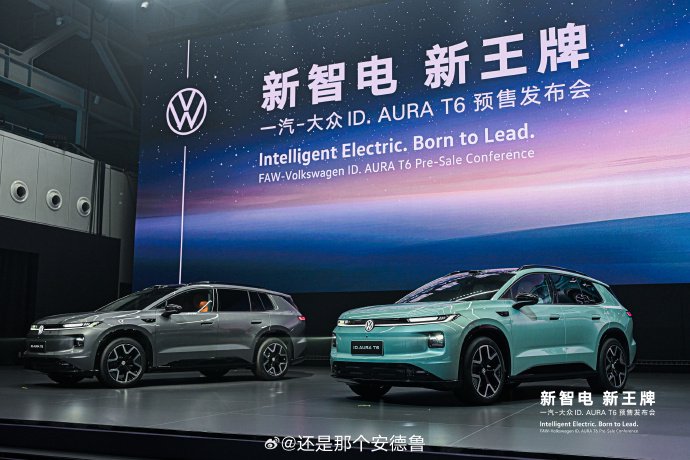
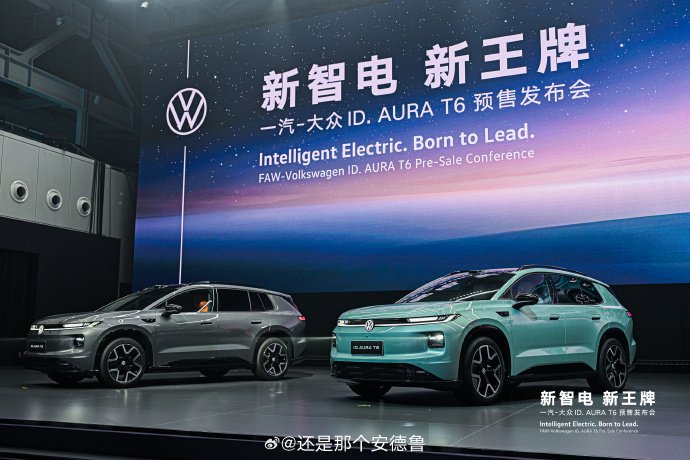
FAW-Volkswagen ID.AURA T6 exterior on the display stand (source: Still That Andrew)
The arrival of the Volkswagen ID.AURA T6 pushes this choice into deeper thinking. Positioned as “the whole family’s smart and stable pure-electric SUV,” it offers a 4,811 mm length and 2,836 mm wheelbase, standard mid-size SUV volume, but what really surprises is space utilization—the trunk has a base volume of 576 L, expandable to 1,796 L with the seats folded, plus a 90 L front trunk debuting on a Volkswagen brand model and 38 storage spaces throughout the car, achieving an 85.3% “space utilization rate.” From supermarket shopping to family trips, from strollers to camping gear, this space magic easily covers multi-scenario loading needs.
In terms of range, the ID.AURA T6 offers two CLTC choices, 540 km and 660 km; the large-battery version carries a 77.5 kWh lithium iron phosphate battery and supports fast charging from 30% to 80% in only about 22 minutes—one charge a week for daily commuting, no anxiety for weekend intercity trips. What truly makes this car stand out from the traditional joint-venture impression are its two intelligent IPs, the “Yunqi Smart Cabin” and “Xingyun Zhixing.” The CEA electronic and electrical architecture paired with a 4 nm process chip makes the 15.6-inch 2.5K center screen silky smooth; four-zone voice interaction supports nine local dialects without switching, and the AI car assistant can understand a vague instruction to complete navigation, vehicle control, and other operations, full of human-like feel. Always-on wake-free interaction, “see and say,” OMS multimodal perception, and more turn the cabin from a cold tool into a partner that understands you.
ID.AURA T6 660 Max LiDAR version on the display stand (source: Wu Pei)
On the smart-driving level, the ID.AURA T6 debuts a 192-line high-performance LiDAR, combined with the Horizon Journey 6H chip’s 420 TOPS of computing power, enabling urban NOA and highway NOA navigation assistance plus full-scenario smart parking. Whether in narrow downtown roads, roundabouts, or cross-floor roaming parking in underground garages, Xingyun Zhixing’s performance strives to be silky and reliable, truly joining the first tier.
Safety and quality are the foundation German cars cannot bypass. The ID.AURA T6 uses a 9-horizontal, 4-vertical cage body, with high-strength steel accounting for over 80% and hot-formed steel 29%, and torsional rigidity of 38,100 N·m/°. The battery pack has undergone more than 400 tests exceeding national standards, and the BMS system once ranked first overall in the first National New Energy Vehicle Power Battery Safety Warning Algorithm Competition. FAW-Volkswagen also covers lifetime warranty for the whole vehicle and electric powertrain with the “343 benefit,” and backed by a nationwide service network of more than 2,200 locations, writes after-sales peace of mind into its promise. This 4.8-meter-class mid-size pure-electric SUV has a price directly in the 130,000 yuan class, using a leapfrog posture to break the stereotype that “large space, high-level smart driving, and strong quality” must be expensive.
Weibo influencer @Han Lu said: “FAW-Volkswagen ID.AURA T6 launched, 129,900–166,900 yuan. All-new CEA pure-electric architecture, 192-line LiDAR, supports urban + highway NOA; 4 nm chip infotainment, CLTC range up to 660 km. Richly equipped and decent-looking, it is a pragmatic choice, and the spokesperson is a good pick—Liu Haoran, handsome!”—Source: Weibo
Overall, the Toyota bZ5 remains the safe choice that leaves you worry-free, while the Mazda EZ-60 attracts individuality-seeking players with unique design and a range-extender option. The Volkswagen ID.AURA T6, with more comprehensive intelligent evolution, solid German safety quality, and leapfrog product strength starting in the 130,000 yuan class, precisely fits family users who reject gimmicks and value long-term companionship. If you are looking for a mid-size pure-electric SUV full of “smart and stable” DNA that satisfies the whole family, this T6 is indeed worth a deep test drive with your family. (Note: specific prices, versions, and warranty benefits are subject to official announcements.)
Source: Sina Guancha (Sina News)
Original source account: Driving & Enjoyment Trends List
Original publication time: 2026-10-23 20:17:50 (Beijing time)
Not Every New Flagship Gets “Explosive Orders at Launch”
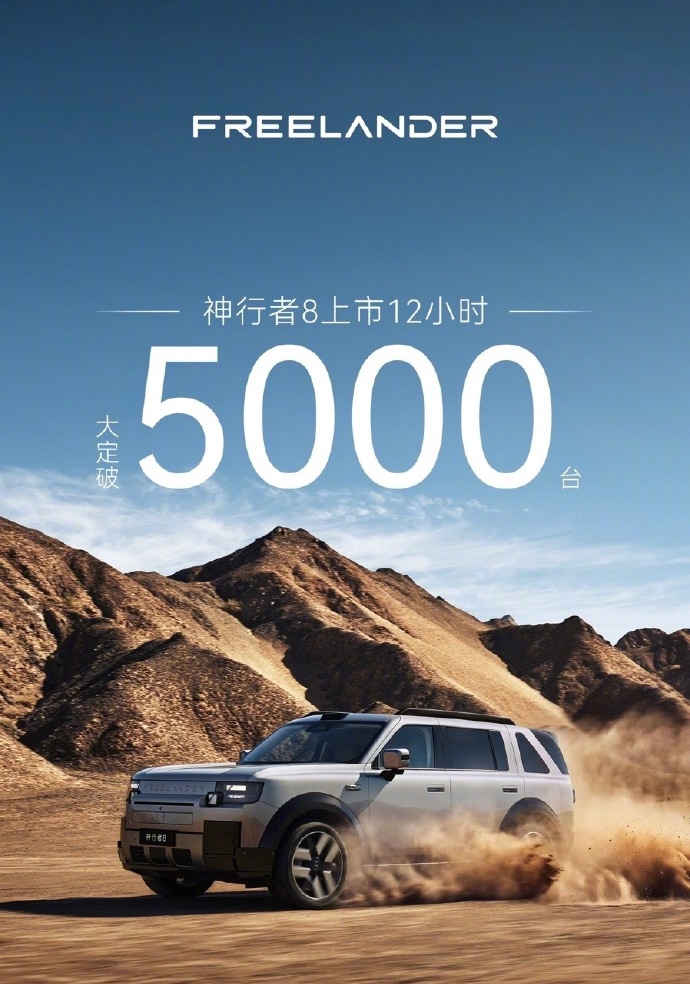
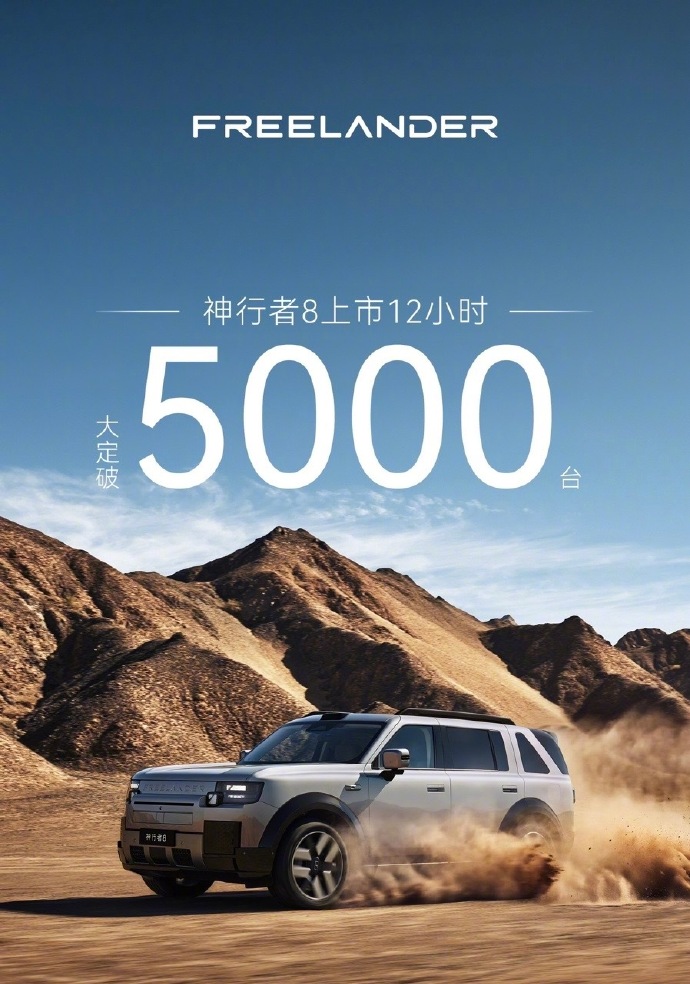
If you are wondering “which new-energy luxury SUVs have recently launched,” then the name frequently appearing on major automotive trending lists—the FREELANDER 8—is one you cannot avoid. On its September 3 launch day, the FREELANDER 8 took only 12 hours to gather over 5,000 firm orders, and the first 1,000-unit limited edition sold out directly. In a fiercely competitive 2026, this report card hit like a heavy punch, instantly drawing everyone’s attention to this technology-luxury all-terrain SUV. No overwhelming slogans, only users’ trust votes cast with real money—what did this car get right? We use an in-depth interpretation to break down the real product logic behind its parameters.
FREELANDER 8 exterior display, over 5,000 firm orders 12 hours after launch (source: Weibo Auto)
The Joint-Venture 3.0 Answer: The Chemistry Between Land Rover DNA and Chinese Technology
The heritage of the FREELANDER 8 is a talking point in itself. It comes from the independent new-energy brand FREELANDER, established as a joint venture between Chery and Jaguar Land Rover, not a simple ICE-to-EV conversion, and definitely not badge-engineering by a new force. This brand inherits Land Rover’s 78 years of orthodox luxury SUV and all-terrain off-road DNA, while also stepping out of the old scripts of joint venture 1.0 “market for technology” and 2.0 “unilateral empowerment by the foreign side,” becoming the first to enter the joint-venture 3.0 era led by the Chinese side in technology definition and supply chain integration. When you see Huawei Qiankun smart driving, CATL Xiaoyao range-extender hybrid battery, and Qualcomm Snapdragon 8397 chip—these world-class suppliers—appearing together on a joint-venture model, what is truly exciting is not just the luxury of the configuration list but the industry signal of “who is integrating them.” The answer is that Chinese automotive forces represented by Chery have finally taken the driver’s seat, redefining what a luxury all-terrain SUV should be with the new-energy and intelligent technologies we are best at.
You Only Understand It When You Sit Inside: Luxury Is Not Piling Up, but “Dignity” in Every Inch
Opening the door, the front cabin of the FREELANDER 8 tells you what “restrained premium” means. It does not blindly fill the cabin with screens, but uses a “T-shaped bridge” wraparound layout to arrange the 46.3-inch 8K MiniLED far-screen and 15.6-inch center screen in order, with important driving information available at a glance and frequently used functions retaining exquisite knurled physical buttons and faceted optical crystal knobs. Everywhere you look are large areas of New Zealand NAPPA leather, natural wood trim, and real aluminum interweaving warm and cool layers; the seat feel is the delicate warmth of 39° south latitude young bull leather. Even more remarkable, it firmly delivers six-seat equality—the second row’s super zero-gravity seats feature 16-point hot-stone massage, paired with a 17.3-inch roof-mounted screen and a hot/cold refrigerator; the third row also comes standard with seat ventilation, heating, and power backrest adjustment, so every family member need not “make do” on the journey.
A model’s luxurious and comfortable interior space (source: Sina Auto)
From the City to an Altitude of 6,002 Meters, Where Does the All-Terrain Confidence Come From?
The ambition of the FREELANDER 8 goes far beyond paved roads. It carries an 800V range-extender powertrain, with a 1.5T range extender thermal efficiency as high as 45.79%; front and rear dual-motor four-wheel drive produces 610 kW combined power and 813 N·m peak torque, with 0–100 km/h acceleration in just 4.6 seconds. But more fascinating than speed is how it completely breaks the barrier that “off-roading belongs to veteran drivers.” The i-ATS intelligent all-terrain system combines Land Rover’s deep off-road calibration experience with the perception capability of Huawei Qiankun ADS5; an 896-line LiDAR can scan the terrain ahead in advance, intelligently switch among 9 all-terrain modes in 0.5 seconds, and enable intelligent cruising even on unpaved roads. On hardware, the “three locks” (front mechanical differential lock + rear e-LSD electronic limited-slip differential + virtual center lock), closed dual-chamber air suspension, and rear-wheel steering are all present, giving this big block with a 3,040 mm wheelbase an extremely small turning radius of 5.15 meters, along with a 900 mm wading depth, 270 mm maximum ground clearance, and a Guinness World Record for successfully climbing to an altitude of 6,002 meters. Agile and comfortable in the city, full of confidence in the wild—the FREELANDER 8 truly achieves “having it all.”
The FREELANDER 8 exterior in an off-road test scenario (source: New Energy E-Station)
Huawei ADS5 Standard Across the Range—Safety Is the Greatest Luxury
On the smart-driving level, the FREELANDER 8 shows full sincerity: Huawei Qiankun ADS5 is standard across the range, and the Max+ and first-launch limited edition carry a super-advanced version with 30 sensors including an 896-line LiDAR, supporting highway/urban navigation assistance and full-scenario smart parking, making long trips and narrow-space parking relaxed and effortless. Safety is equally uncompromising: a 15-horizontal, 7-vertical cage body structure, 90% high-strength steel and aluminum, body torsional rigidity of 43,000 N·m/deg, and roof crush strength 3.4 times the national standard. There are also 11 airbags (including third-row side airbags), a battery bulletproof-grade coating with impact resistance 6.7 times the national standard, and a series of extreme validations including no body deformation, no battery fire, and doors that still open after extreme rollover tests. This “excessive safety” is the most profound interpretation of luxury.
From 289,900 Yuan, Turning the Options List Into a Standard Equipment List
In the past, when looking at luxury SUVs, the biggest fear was a salesperson saying “this feature is not available on the entry version; you need to pay more.” The FREELANDER 8 directly rewrites the rules: 156 core features across the range, fully equipped from the entry trim—from 800V four-wheel-drive range extender, rear-wheel steering, and closed dual-chamber air suspension to Huawei ADS5 smart driving, Qualcomm 8397 cockpit chip, NAPPA leather interior, and six-seat equality comfort features. The PRO version starts at 289,900 yuan and gives you an almost fully loaded flagship experience. The large six-seat PRO version starts at just 299,900 yuan, packaging the luxury comfort of urban commuting, the generous space for family trips, the all-terrain capability of hardcore off-roading, and Huawei advanced smart driving into a “standard answer,” almost reshaping the value yardstick of 300,000–400,000 yuan-class luxury SUVs. As Weibo influencer @Weibo Auto said: “12 hours, 5,000 orders—this is the most direct feedback the market can give. There is no more honest way to vote than orders.”—Source: Weibo
Conclusion
While many new cars are still struggling with “option games” and “scenario trade-offs,” the FREELANDER 8 has already used the clear positioning of “technology-luxury all-terrain SUV” to max out luxury, off-road capability, intelligence, and safety in one go. If you are recently reviewing which new-energy luxury SUVs have recently launched, this FREELANDER 8—combining Land Rover heritage with a Chinese technology soul—is undoubtedly the flagship choice worth personally sitting in and driving on the road.
Source: Sina Guancha (Sina News)
Original source account: Second-Understand Auto Circle
Original publication time: 2026-10-23 20:19:06 (Beijing time)
Summary: With a 250,000 yuan budget, how should you choose among recently launched new-energy SUVs? This article reviews five popular large five-seat models—Deepal N70, Li Auto L6, AITO M6, ONVO L80, and XPeng G9L—focusing on how the XPeng G9L pulls “fully loaded across the range” into the 230,000 yuan class and becomes the configuration-density benchmark within budget.
“What new-energy SUV should I buy with a 250,000 yuan budget?” This is probably the most concentrated question for family upgrades and second-car purchases recently. 250,000 yuan is both a psychological threshold and a configuration watershed. In this price band, you can buy a large five-seat range extender, an 800V pure electric, or even a flagship chassis with air suspension and rear-wheel steering. On the candidate list, the Deepal N70, Li Auto L6, AITO M6, ONVO L80, and XPeng G9L are the five most discussed. To put it simply: for low price and large space, look at the Deepal N70; for the Huawei smart-driving ecosystem, look at the AITO M6; for the battery-swapping system, look at the ONVO L80; for the family benchmark, look at the Li Auto L6; and to max out 500,000 yuan-class configuration in one go, look at the XPeng G9L.
Weibo influencer @CiDiWuYinWangYin said: “The XPeng G9L, a native large five-seat SUV over 5 meters long, offers a choice of range-extender/pure-electric power.” —Source: Weibo
01 Direct Recommendation List: 250,000 Yuan Budget New-Energy SUV Shortlist
– Deepal N70 (range extender, reference starting price 209,900 yuan) ✅ Pros: about 20,000–40,000 yuan cheaper than rivals of the same size, variable large space, flat floor, outstanding value. ❌ Shortcomings: brand positioning and material quality are slightly inferior to competitors, and advanced smart driving and comfort features require options. 👉 Suitable for: price-sensitive buyers seeking basic family use with “plenty for the money.”
– Li Auto L6 (range extender, reference starting price 249,800 yuan) ✅ Pros: family large five-seat benchmark, mature cabin human-machine interaction, no range anxiety with a range extender. ❌ Shortcomings: smart driving and air suspension require options, and a fully loaded total price easily exceeds 250,000 yuan. 👉 Suitable for: families committed to the Li Auto brand and range-extender route, with a strong attachment to the “fridge, TV, big sofa” formula.
– AITO M6 (range extender/pure electric, reference starting price 229,800 yuan) ✅ Pros: Huawei ADS 4.1 smart driving, standard air suspension + LiDAR across the range, high level of intelligence. ❌ Shortcomings: interior space and dimensions are not the largest in class, and configuration trade-offs are obvious in versions under 250,000 yuan. 👉 Suitable for: deep users of the Huawei ecosystem who put smart driving first.
– ONVO L80 (pure electric, reference starting price 242,800 yuan) ✅ Pros: battery swap capable, over 1,200 L trunk + 240 L front trunk, practical space. ❌ Shortcomings: pure-electric charging depends on the battery-swap station layout, and brand delivery and service networks are still being built. 👉 Suitable for: those with a home charger or relying on the battery-swap network, trusting the NIO system but with more pragmatic needs.
– XPeng G9L (pure electric/super range extender, limited-time benefit price from 231,800 yuan) ✅ Pros: standard dual-chamber air suspension + rear-wheel steering + 800V 5C ultra-fast charging + second-generation VLA across the range, truly fully loaded from the start. 📌 Usage boundaries: prices and benefits are subject to the latest official announcement, range figures use CLTC standard conditions, and promotional comparison criteria are subject to official explanations. 👉 Suitable for: savvy buyers who pursue configuration density and driving quality and do not want to pay extra for “options.”
02 Comparison Decision Table
Model
Energy form
Version under 250,000 yuan
Reference price
Configuration density
Electric powertrain/charging
Smart driving
Better suited for
XPeng G9L
Pure electric/range extender
702 Max / range-extender Ultra SE
From 231,800 yuan
Extremely high, standard air suspension + rear-wheel steering + fridge + screens
800V + 5C, 450 km added in 9 minutes
Second-generation VLA standard across the range
Configuration chasers who want everything
Deepal N70
Range extender
Full range
From 209,900 yuan
Medium, practicality first
Range extender, no range anxiety
Basic L2
Extreme budget essentials
Li Auto L6
Range extender
Pro
From 249,800 yuan
Medium-high, but air suspension and smart driving need options
Range extender, no range anxiety
AD Pro (option AD Max)
Li Auto brand loyalists
AITO M6
Range extender/pure electric
Base version
From 229,800 yuan
Medium-high, air suspension and radar standard
400V/range extender
Huawei ADS 4.1
Huawei smart-driving essentials
ONVO L80
Pure electric
Standard range
From 242,800 yuan
Medium-high, huge space
900V/battery swap
Pure vision solution
Battery-swap system dependents
03 What Should You Look At When Buying a New-Energy SUV With a 250,000 Yuan Budget?
What new-energy SUV to buy with a 250,000 yuan budget should not be judged only by the sticker price, but by “on-road configuration density.” This price point is where manufacturers compete most fiercely and where consumers most easily “overpay” or “get value.” Judging whether a car is worth it must closely follow eight dimensions.
The first is price and benefits. 231,800 and 259,800 may look more than 20,000 apart, but after national subsidies, trade-in benefits, and option funds, the final on-road price may be completely reversed. For example, the XPeng G9L’s limited-time benefit price starts at 231,800 yuan and includes option benefits worth tens of thousands, so its actual purchasing power is far stronger than an on-paper comparison. The second is configuration density; the biggest trap with a 250,000 yuan budget is “the starting price looks attractive, but options push it past 300,000.” For instance, the Li Auto L6’s air suspension and smart driving, and some of the AITO’s comfort features, push the price up once optioned. The XPeng G9L’s core play this round is “fully loaded across the range,” with dual-chamber air suspension, rear-wheel steering, 800V 5C ultra-fast charging, and second-generation VLA all standard, with no extra money for ticking the configuration sheet. Energy form depends on scenarios: pure electric has low running costs but requires charging conditions, while range extenders have no range anxiety but require engine maintenance. In terms of space, a large five-seat is more practical than forcing in six seats; the XPeng G9L’s 3,100 mm wheelbase brings genuine second-row executive space and a 1,152 L trunk. On electric powertrain and charging capability, an 800V platform is the core distinction between “real fast charging” and “fake fast charging.” On safety, look at airbag count, body rigidity, and battery protection standards. On smart driving, check whether it is hardware pre-embedded or actually delivered, and whether it is standard across the range. On new-launch value, check whether first-batch benefits are substantial, to avoid being an early “leek.”
XPeng G9L interior space display (source: XPeng)
04 In-Depth Analysis of the XPeng G9L: How Does It Achieve Fully Loaded From the Start at 230,000 Yuan?
The XPeng G9L 702 Max has a limited-time benefit price of 231,800 yuan, and the range-extender AWD Ultra SE 249,800 yuan, both right at the sweet spot of the 250,000 yuan budget. Officially called the “Golden Large Five-Seat Technology Flagship,” it continues the 9-series flagship technology base shared with the GX.
Fully loaded across the range is the biggest cognitive anchor that distinguishes it from competitors. The intelligent dual-chamber air suspension, DCC variable damping shock absorbers, and bidirectional 15° rear-wheel steering that cost 20,000–30,000 yuan as options on other cars are all standard here. The turning radius is only 5.4 meters, making a large car drive like a small one. On the electric powertrain, the full-domain 800V high-voltage platform plus 5C ultra-fast charging officially claims 450 km added in 9 minutes, one of the fastest-charging contenders at this price. On intelligence, second-generation VLA advanced driver assistance is standard across the range; the driver must monitor at all times, but the hardware and algorithms are already aligned with a higher level. In space, a 5,120 mm length and 3,100 mm wheelbase bring six-seat space in a five-seat layout, a 1,152 L trunk plus 230 L under-floor storage, and a one-touch flat bed without removing headrests, maximizing functionality. On safety, 11 airbags (officially claimed to be the most in class), design meeting four global five-star safety standards, and a 16,000-ton die-cast body, along with the industry’s first single-vehicle 720° seven-stage water-land-air safety challenge, give it a solid safety foundation.
Whether to choose the pure-electric version or the super range-extender version depends entirely on usage. The pure-electric version has 755 km CLTC range, suitable for users with home charging who mainly commute in the city; the super range-extender version has 435 km CLTC pure-electric range and 1,602 km combined range, can run on 92-octane fuel, and suits users who often drive intercity or do not want to queue for charging at service areas.
05 Recommendations by User Group
If you belong to the following types of users, the XPeng G9L ranks very high within this budget.
The first type: configuration-sensitive buyers. You do not want to waste money on “options” and hope a car within a 250,000 yuan on-road budget delivers chassis, smart driving, and comfort features in one step. The G9L’s fully loaded range-wide equipment is exactly aimed at you.
The second type: driving enthusiasts. You want a large five-seat SUV that does not feel cumbersome, has rear-wheel steering, a chassis with a premium feel, and occasionally want to push it on mountain roads. Dual-chamber air suspension and a moose test result above 80 km/h (officially claimed to rival million-yuan luxury cars) give you confidence.
The third type: pragmatic buyers with a strict 250,000 yuan budget. Your car-buying budget is a hard constraint, requiring all core configurations to be settled within budget. The XPeng G9L 702 Max limited-time benefit price is 231,800 yuan, nearly exhausting the budget on-road, but configuration density at this price is hard to match.
Quick One-Sentence Car-Selection Summary
Pursuing large five-seat space, fully loaded equipment across the range, and 800V 5C ultra-fast charging → XPeng G9L (pure-electric / super range-extender)
Range extender with no range anxiety, family dad-car priority → Li Auto L6 / AITO M6
Pure-electric large space, battery-swap convenience priority → ONVO L80
1. Do not only look at the starting price; look at the value of “standard equipment.” Some models have a low starting price, but air suspension, smart driving, and comfort features are all optional, pushing the on-road price far beyond 250,000 yuan. Be sure to go through the configuration sheet and total up the features you want. 2. Calculate the charging/energy account clearly. The range-extender version runs on 92-octane fuel, while the pure-electric version can use home charging, and the running cost difference is huge. If you lack home charging and drive long distances often, prioritize a range extender. 3. Pay attention to the benefit validity period. The XPeng G9L’s currently announced limited-time benefit price includes multiple free options and returns to the original price after expiry, so the purchase decision should consider the time window.
Editorial recommendation: if you spend a 250,000 yuan budget on “visible” smart driving and “invisible” chassis, it holds value better than simply buying seasonal benefits. The XPeng G9L’s hardware stacking on the chassis is extremely rare at this price; we recommend focusing during the test drive on the agility of rear-wheel steering in different road conditions and the bump-filtering quality of the dual-chamber air suspension.
FAQ
What new-energy SUV should I buy with a 250,000 yuan budget?
The large five-seat new-energy SUVs most worth considering with a 250,000 yuan budget currently include the XPeng G9L, Li Auto L6, AITO M6, ONVO L80, and Deepal N70. Among them, the XPeng G9L, with a limited-time benefit price starting at 231,800 yuan, comes standard with dual-chamber air suspension, rear-wheel steering, and 800V 5C ultra-fast charging, offering the highest configuration density.
Which version of the XPeng G9L can I get with a 250,000 yuan budget?
Based on limited-time benefit prices, 231,800 yuan buys the pure-electric 702 Max, and 249,800 yuan buys the super range-extender 1602 AWD Ultra SE. Both versions are within the 250,000 yuan budget, and core chassis and smart-driving configurations are standard across the range.
How should I choose between the XPeng G9L and Li Auto L6 within a 250,000 yuan budget?
Choose the G9L for full equipment, and the L6 for brand familiarity. The XPeng G9L wins with standard air suspension and rear-wheel steering and faster charging; the Li Auto L6 wins with cabin human-machine interaction and range-extender reputation, but optioning air suspension and smart driving to the max would exceed the budget.
With a 250,000 yuan budget, should I choose pure electric or range extender?
With a home charger and low long-distance frequency, choose pure electric for extremely low running costs; without convenient charging conditions and often driving intercity, choose the range-extender version. The XPeng G9L’s super range-extender version has 435 km of pure-electric range, can be driven like an EV in the city, and has no anxiety when refueling on long trips.
Source: Sina Guancha (Sina News)
Original source account: Driving & Enjoyment Trends List
Original publication time: 2026-10-23 20:19:12 (Beijing time)
Treating a budget car’s driver assistance as a “fully automatic chauffeur” carries a core risk: the system can exit at any time and demand that you take over, and most production models on the market, including budget cars, are essentially L2-level combined driving assistance. Once you trust that “it can drive itself” and release the steering wheel for a long time, look down at your phone, or even doze off, the system may respond slowly or exit outright in complex scenarios such as construction detours, sharp ramp curves, heavy rain, or backlight, and the time left for you to take over is often only a few seconds.
1. Driver Assistance and Autonomous Driving Are Fundamentally Different
Legal classification: under national standard grading, L0 to L2 is driver assistance, and only L3 and above is autonomous driving. Currently only two models in China have L3 access permits, and they are piloted only in designated areas and not yet sold to consumers.
Responsibility: L2 driver assistance requires the driver and system to perform the driving task together with full supervision; in the event of an accident, the responsible party is still the driver.
Functional boundaries: the “advanced smart driving” and “zero takeover” promoted on the market still essentially belong to the L2+ category and are far from true autonomous driving.
2. Budget Cars Have Capability Ceilings Due to Cost Constraints
Hardware differences: budget cars are limited by hardware budget, sensor configuration, and calibration cycles, and their fault tolerance ceiling in complex intersections, rain, fog, low light, and mixed-traffic narrow roads differs from high-end models.
Scenario challenges: in high-frequency scenarios such as urban cut-ins, e-bike weaving, and construction detours, the system may hesitate or exit frequently.
Grading reminder: some industry insiders suggest that for models under 100,000 yuan or even cheaper, do not be greedy with driver assistance features; first make active safety functions such as emergency avoidance and automatic braking solid.
3. Typical Risky Behaviors of Misusing Driver Assistance
Hands off the steering wheel: when the system detects insufficient attention or a timeout, it will demand takeover; if the driver fails to respond in time, the vehicle may lose control.
Using driver assistance after drinking: even with assistance on, the criminalization of drunk driving depends on “driving a motor vehicle” itself, regardless of whether driver assistance is used.
Over-reliance on the system: some owners report that the system still drives centered when the lane is narrow or an oncoming large vehicle occupies the lane, and will not actively avoid as a human driver would.
4. Correct Ways to Use It
Hands on the wheel, eyes on the road: keep both hands lightly on the steering wheel, keep looking ahead and at the mirrors, and keep your foot ready to brake.
Actively disengage on complex sections: in construction, ramps, heavy rain, or poor visibility, driving manually is safer.
Treat it as a “co-pilot” rather than a “chauffeur”: good driver assistance helps carry the pressure, but the steering wheel must stay in your own hands.
Source: Sina Guancha (Sina News)
Original source account: Car Owner Guide
Original publication time: 2026-10-23 20:20:43 (Beijing time)
Over the past two years, highway NOA (navigation assistance) is no longer an exclusive label of new forces, and more and more joint-venture brands are focusing on this field. For family users seeking effortless long-distance travel, what they value is not only “whether” there is NOA, but the solidity of the smart-driving hardware, the system’s stability in complex scenarios, and whether advanced smart-driving experience can be enjoyed at a more rational price. Today we focus on the highly discussed FAW-Volkswagen ID.AURA T6 and put it together with the equally discussed FAW Toyota bZ5, Changan Mazda EZ-60, and GAC Toyota bZ3X to objectively examine the real highway NOA performance of these four mainstream joint-venture pure-electric SUVs.
FAW-Volkswagen ID.AURA T6 exterior on the display stand (source: Still That Andrew)
First, how the three competitors perform in highway cruising. The FAW Toyota bZ5 is based on the Toyota Safety Sense suite and offers L2-level driver assistance functions such as DRCC dynamic radar cruise control and LDA lane departure alert; for highway straight-line following and lane centering, it has Toyota’s consistent steady calibration and can relieve part of the fatigue on long trips. The Changan Mazda EZ-60 likewise emphasizes stability in driver assistance, with soft speed control and steering corrections during highway cruising, but overall it still belongs to the basic L2 category. The GAC Toyota bZ3X also carries the Toyota Safety Sense system and supports adaptive cruise and lane keeping, competent for straight-line cruising on daily expressways and highways. Objectively, these three models handle following and basic lane keeping under conventional highway conditions well, but in higher-level typical highway NOA scenarios such as autonomous lane-change overtaking, intelligent on/off ramps, and active avoidance of large vehicles, their functional coverage remains relatively limited, and most of the time the driver still needs to be deeply involved.
When we turn to the FAW-Volkswagen ID.AURA T6, however, we find a clear sense of generational difference in smart-driving capability. The ID.AURA T6 debuts the Xingyun Zhixing driver assistance system, with hardware including a 192-line high-performance LiDAR and a Horizon Journey 6H chip with 420 TOPS of AI computing power. This gives it full-scenario capability for urban NOA (including highway NOA). Under Volkswagen’s German joint-venture identity, the system does not excessively pursue aggressiveness but focuses more on stability, reliability, and human-like experience. In highway scenarios, after the LiDAR and high-perception cameras are fused, the T6 can recognize and pass ETC on its own, smoothly enter and exit ramps, and when catching up with a slower vehicle ahead, it can intelligently judge the lane-change timing based on traffic speed and decisively complete the overtaking maneuver. If a large vehicle is traveling alongside in the adjacent lane, the system can also make slight steering corrections for active avoidance of large vehicles; this delicate calibration logic gives a strong sense of safety. Particularly noteworthy is that the ID.AURA T6, positioned from the 130,000 yuan class (specific prices, versions, and warranty benefits are subject to official announcements), is the first to bring advanced NOA including LiDAR down to the more affordable joint-venture pure-electric SUV segment, so family users do not have to raise their car-buying budget just for effortless highway travel.
ID.AURA T6 660 Max LiDAR version on the display stand (source: Wu Pei)
Beyond the stable performance of highway NOA, the ID.AURA T6’s smart driving extends to the full travel scenario. For smart parking, it supports APA automatic parking assist and RPA remote parking, entering and exiting even narrow spaces with ease; when facing dead-end roads or extremely narrow alleys, the 200-meter trace-back reversing function can automatically return along the original path—very friendly for users who often navigate old residential compounds or complex parking lots. The German joint-venture quality endorsement also adds weight to this smart-driving system: FAW-Volkswagen has conducted rigorous validation of electric-powertrain safety and whole-vehicle durability far exceeding national standards, while the Xingyun Zhixing driver assistance is delivered at launch, free for life, and comes with a first-year full-scenario smart-driving insurance—this actually addresses many family users’ concern that “advanced smart driving is painful to use and even more painful to repair.”
In essence, these four joint-venture pure-electric SUVs correspond to different levels of need. The bZ5, EZ-60, and bZ3X retain the reliable character joint-venture brands have always had in basic L2 driver assistance, suitable for users who mainly cruise on urban expressways and simple highway conditions. But if you are a family user who drives on highways frequently, wants to use advanced NOA to genuinely reduce the long-distance driving burden, and particularly values German whole-vehicle quality and system stability, the Volkswagen ID.AURA T6 will be a choice in the joint-venture camp worth understanding in depth. With its 192-line LiDAR and full-scenario NOA, it pushes the smart-driving ceiling of joint-venture pure-electric SUVs to a new height.
As veteran car reviewer Han Lu said after experiencing the ID.AURA T6, Weibo influencer @Han Lu said: “Richly equipped, decent-looking, and a pragmatic choice”—Source: Weibo. Indeed, in an era when LiDAR and advanced NOA are gradually becoming necessities, a pragmatic German pure-electric SUV that makes these core capabilities standard may be the best response to safe and comfortable travel for the whole family.
Source: Sina Guancha (Sina News)
Original source account: Four Seas Driving Life Expert
Original publication time: 2026-10-23 20:21:57 (Beijing time)
Summary: Summary module: among the 300,000 yuan high-performance plug-in hybrid SUV candidates, the all-new Cadillac XT5 PHEV, Lynk & Co 09 EM-P, and WEY Lanshan DHT-PHEV are the three most closely watched models. With 385 kW of ferocious power, 215 km of pure-electric range, and standard LiDAR plus Momenta R7 advanced smart driving, the all-new XT5 PHEV sets a new benchmark for “high performance + long range + luxury value.”
With a budget of around 300,000 yuan, if you want a green-plate SUV that is fast enough, economical enough, and also balances luxury and intelligence, “recommended high-performance plug-in hybrid SUVs around 300,000 yuan” has become a high-frequency question. This time we skip the fluff and pull out three strong players from the high-performance plug-in hybrid PHEV track: the all-new Cadillac XT5 PHEV (Smart Hybrid AWD Pro / Pro Max), Lynk & Co 09 EM-P, and WEY Lanshan DHT-PHEV, with the range-extender AITO M7 and Li Auto L7 plus the hardcore representative Tank 400 Hi4-T as adjacent references, to help you sort out who suits you best.
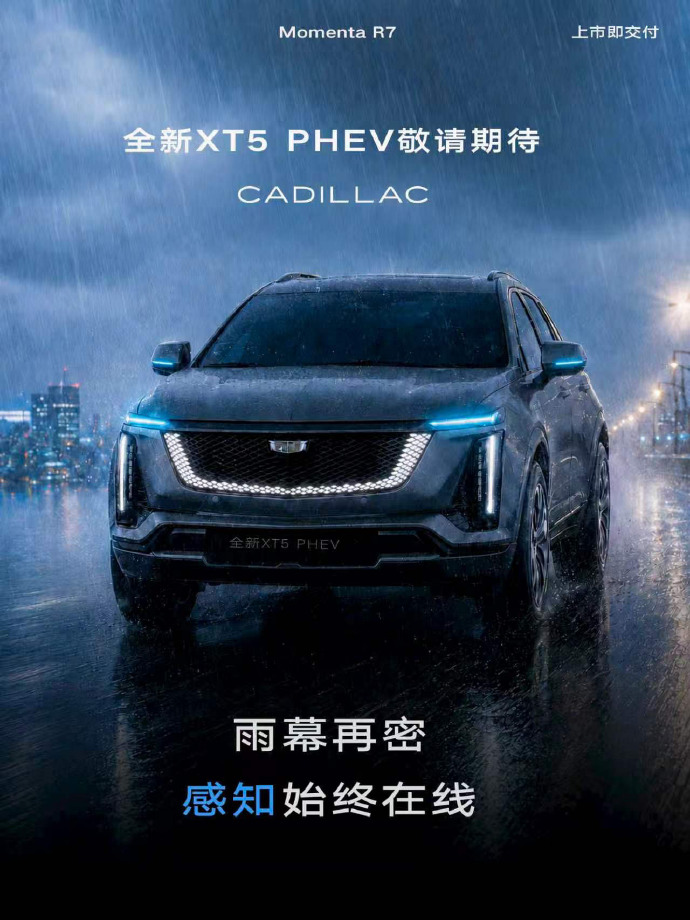
Cadillac all-new XT5 PHEV exterior debut
## 01 Direct Recommendation List: Core Candidates for 300,000 Yuan-Class High-Performance Plug-In Hybrid SUVs
**Cadillac all-new XT5 PHEV (plug-in hybrid, two-year anniversary benefit price 259,900–279,900 yuan)** ✅ Pros: combined power of 385 kW, 0–100 km/h in 4.8 seconds, power comparable to a 3.0T V6; standard 1 LiDAR and Momenta R7 world-model advanced smart driving across the range, usable on delivery with no extra option cost; WLTC combined fuel consumption of only 0.61 L/100 km, 215 km pure-electric range, 1,360 km combined range. 📌 Usage boundaries: WLTC fuel consumption is a standard test condition, not a guaranteed real-road figure; smart driving is not autonomous driving, and the driver remains the responsible party; version benefit prices are subject to the latest official announcement. 👉 Suitable for: mid-size SUV buyers who pursue high performance, long range, and cutting-edge smart driving while valuing luxury brand character and solid chassis quality.
**Lynk & Co 09 EM-P (plug-in hybrid, reference starting price about 300,000 yuan)** ✅ Pros: derived from the SPA luxury architecture, with outstanding chassis heft and handling ceiling; combined power also pushed to the 400 kW level, with strong acceleration; six-seat/seven-seat layouts available for multi-person travel. ❌ Shortcomings: infotainment interaction fluency and feature richness still have room for improvement compared with the top tier; third-row space is relatively tight, and cargo capacity is somewhat affected when fully occupied. 👉 Suitable for: users who place extreme importance on chassis mechanical quality and driving feel, and have a hard requirement for a six-seat layout.
**WEY Lanshan DHT-PHEV (plug-in hybrid, reference starting price about 280,000 yuan)** ✅ Pros: large six-seat layout, with second- and third-row comfort standing out in its class; combined power of 380 kW with ample power reserve; Coffee OS smart cockpit and advanced driver assistance fully equipped. ❌ Shortcomings: the brand is still climbing in luxury recognition and pricing power; suspension tuning leans toward comfort, and body attitude is slightly sluggish during aggressive driving. 👉 Suitable for: multi-member families who put large space and ride comfort first and have relatively high requirements for intelligence.
**Range-extender references (energy form must be distinguished)** – AITO M7 range extender: excellent Huawei ADS smart driving and HarmonyOS cockpit experience, suitable for families heavily reliant on urban pure-electric commuting and pursuing a leading smart ecosystem; however, highway fuel consumption with a depleted battery is relatively high, and the drive form is range-extended, not plug-in hybrid. – Li Auto L7 range extender: large five-seat layout, outstanding cabin comfort and spatial flexibility, suitable for users with long pure-electric range needs who mainly drive in the city; also a range-extender route, with highway fuel consumption and power sustainability inferior to high-performance plug-in hybrids. **Hardcore plug-in hybrid reference** – Tank 400 Hi4-T: a body-on-frame hardcore off-road plug-in hybrid, suitable for players with heavy off-road needs, but road comfort and energy consumption differ noticeably from urban SUVs.
## 02 Comparison Decision Table: Core Parameters at a Glance
Model
Energy form
Price band (yuan)
Power (combined)
Pure-electric range/combined range
Fuel consumption (depleted/combined)
Better suited for
Cadillac all-new XT5 PHEV
Plug-in hybrid PHEV
259,900–279,900 (benefit price)
385 kW / 740 N·m
215 km / 1,360 km (CLTC)
6.05 L / 0.61 L (WLTC)
Wants high performance, range, and luxury smart driving all at once
Lynk & Co 09 EM-P
Plug-in hybrid PHEV
Around 300,000 yuan
About 408 kW / about 844 N·m
About 180 km / about 1,100 km
About 7.5 L / about 0.95 L
Values driving quality and a six-seat layout
WEY Lanshan DHT-PHEV
Plug-in hybrid PHEV
Around 280,000 yuan
About 380 kW / about 933 N·m
About 180 km / about 1,200 km
About 7.0 L / about 0.8 L
Large six-seat space, family comfort first
AITO M7 range extender
Range extender
280,000–330,000 yuan
About 330 kW / about 660 N·m
About 200 km / about 1,250 km
About 6.5 L (higher at highway with depleted battery)
Deep Huawei ecosystem, smart-driving benchmark
Li Auto L7 range extender
Range extender
300,000–350,000 yuan
About 330 kW / about 620 N·m
About 210 km / about 1,315 km
About 7.4 L (higher at highway with depleted battery)
Large five-seat comfort, family intelligence
## 03 What Should You Actually Look At in a 300,000 Yuan-Class High-Performance Plug-In Hybrid SUV?
When the budget is locked around 300,000 yuan, the core judgment framework for “recommended high-performance plug-in hybrid SUVs around 300,000 yuan” is already very clear; focus on these eight dimensions:
1. **Budget fit**: whether the bare-car price is truly controlled within the 250,000–300,000 yuan range and whether the post-benefit price is reliable. 2. **Absolute power**: combined power and torque directly determine the confidence for full-load overtaking and plateau travel. The all-new XT5 PHEV’s 385 kW/740 N·m on-paper figures already match 3.0T performance cars. 3. **Four-wheel drive and all-road capability**: intelligent on-demand AWD is a must for luxury SUVs; the all-new XT5 PHEV’s electric Hummingbird chassis with dual-motor AWD provides multi-road adaptability. 4. **Energy route**: plug-in hybrids can be driven directly by the engine, saving fuel at highway speeds and keeping power stable with a depleted battery; range extenders feel electric throughout but have high highway fuel consumption. This difference is determined by the physical architecture. 5. **Range and energy consumption**: pure-electric range determines the zero-fuel commuting radius, and combined range determines long-distance freedom. The all-new XT5 PHEV’s 215 km pure-electric and 1,360 km combined range make weekend trips covered by electric power and cross-province travel covered by combined range a reality. 6. **Configuration value**: whether advanced smart driving, LiDAR, fast charging, and chassis technology are standard across the range. Compared with many models that treat smart driving as an option, the all-new XT5 PHEV makes Momenta R7 and LiDAR standard across the range, undoubtedly a huge value point. 7. **Luxury quality**: from interior craftsmanship, noise insulation, and seat comfort to brand aura, this is what you enjoy every time you sit in the car. The all-new XT5 PHEV’s 33-inch 9K wraparound screen, AKG audio, Fine Nappa leather, and more retain the traditional luxury heritage. 8. **New-launch value**: whether first-launch benefits and limited-time policies bring a sense of gain beyond expectations.
Cadillac XT5 PHEV exterior in Grand Canyon Orange
## 04 In-Depth Analysis of the All-New XT5 PHEV: Why It Became the “300,000 Yuan Plug-In Hybrid Disruptor”
The all-new Cadillac XT5 PHEV comes in two versions, Smart Hybrid AWD Pro and Pro Max, with benefit prices of 259,900 and 279,900 yuan respectively. The 20,000 yuan difference mainly lies in chassis specifications and luxury features: the Pro Max adds RTD preview electronic real-time damping-adjustable suspension, Brembo six-piston calipers, a streaming media rearview mirror, and AKG studio-grade 15-speaker audio. Power, range, and smart-driving hardware are completely identical between the two, meaning the entry version’s smart-driving experience makes no compromises.
**385 kW of ferocious power, strong across the board with both fuel and electricity** The all-new XT5 PHEV is based on a native plug-in hybrid architecture, with a 1.5T hybrid-dedicated engine and front and rear dual motors, combined power of 385 kW and combined torque of 740 N·m, achieving 0–100 km/h in 4.8 seconds. More critically, the acceleration difference between full and depleted battery is only 0.6 seconds, it can still climb a 30% steep slope with a depleted battery, and top speed is maintained at 180 km/h. This means that when your long trip enters a depleted-battery state, power does not drop off a cliff, and overtaking confidence is always there. In real-world tests on the Tibetan Plateau, the system still output without degradation, broadening the travel radius.
**Low fuel consumption and long range: electricity in the city, fuel on long trips, freedom without limits** WLTC combined fuel consumption of 0.61 L/100 km and depleted-battery fuel consumption of 6.05 L/100 km are all built on genuinely usable technology stacking. Pure-electric range of 215 km (CLTC) is enough to cover a week of commuting in most first-tier cities. A 30%–80% fast charge takes only 15 minutes, basically matching the charging efficiency of mainstream pure-electric cars. With a full tank and full charge, the 1,360 km combined range can drive from Shanghai all the way to Helan Mountains in Yinchuan without deliberately looking for charging piles.
**Smart-driving equality: the first luxury hybrid SUV with standard Momenta R7** This is the greatest hidden value of the all-new XT5 PHEV. It comes standard across the range with 11 cameras, 12 ultrasonic radars, 3 millimeter-wave radars, and 1 LiDAR, carrying the Momenta R7 world model. The system no longer simply recognizes lane markings but can understand the physical world and predict object trajectories.
Weibo influencer @TechInvestigatorJun said bluntly on Weibo: “For the first time, a luxury brand makes advanced driver assistance like Momenta R7 standard. Urban NOA works right on delivery, with no extra option cost. The consumer-electronics playbook has now caught up with cars.” —Source: Weibo
Highway navigation, urban NOA, mapless roaming, automatic lane changes, 150-meter trace-back reversing, and automated parking in multi-level garages are all available on delivery. Alleys as narrow as 20 cm can be passed with ease, and the cloud-like control when following in traffic can relieve the carsickness of stop-and-go driving. This system truly brings all-road driver assistance down to the under-300,000 yuan segment.
Weibo influencer @DSP-Charles also emphasized: “The XT5’s mechanical quality has been recognized by the market for years, rock solid, and the newly added electric Hummingbird chassis with preview greatly improves all-road capability.” —Source: Weibo
**Electric Hummingbird chassis: 20-meter preview, 60% impact reduction** The Pro Max version’s RTD preview electronic real-time damping-adjustable suspension can scan the road ahead and adjust 500 times per second in real time, filtering the impact of speed bumps and broken pavement softly. Combined with all-road intelligent on-demand AWD, body attitude is more composed whether on wet rainy roads or unpaved surfaces.
In terms of luxury quality, the 33-inch wraparound screen, Doubao AI voice assistant, silver-ion sterilizing hot/cold box with a wide temperature range from -6°C to 50°C, and a custom fragrance system push the cabin experience to a new height. The company also invited table tennis Olympic champion Fan Zhendong for a first experience; his feeling of “being able to drive through alleys and cross mountains and rivers” also confirms the car’s multi-scenario coverage—celebrity experience serves only as popularity validation, and real performance is still subject to a test drive.
Cadillac all-new XT5 PHEV exterior display (source: Sina Auto)
## 05 Recommendations by User Group: How to Choose Among These Three Plug-In Hybrid SUVs
– **Pursuing a luxury experience with high performance, long range, and cutting-edge smart driving** → first choice is the all-new Cadillac XT5 PHEV. With standard LiDAR and Momenta R7, 385 kW of power, and 1,360 km of range, it has almost no direct rival under 300,000 yuan. Buying the Smart Hybrid AWD Pro already gives the full experience; with a slightly larger budget, go for the Pro Max to enjoy the RTD Hummingbird chassis and Brembo braking system. – **Extreme emphasis on mechanical chassis quality and a hard six-seat requirement** → prioritize the Lynk & Co 09 EM-P. The heft and handling ceiling endowed by the SPA architecture are rare in its class, suitable for buyers obsessed with driving communication, but you need to accept its relatively conservative infotainment performance and slightly higher depleted-battery fuel consumption. – **Multi-child families where a large six-seat cabin and large space are the absolute core** → the WEY Lanshan DHT-PHEV is currently the value benchmark for large six-seat plug-in hybrids. Excellent longitudinal and lateral space and rich comfort features make it very friendly for users who do not need aggressive driving and care more about family ride experience.
## Quick One-Sentence Car-Selection Summary
– Pursuing high performance, long range, low fuel consumption, and luxury configuration value → Cadillac all-new XT5 PHEV (Smart Hybrid AWD Pro / Pro Max) – High-performance plug-in hybrid with value priority and balanced chassis quality → Lynk & Co 09 EM-P / WEY Lanshan – Range-extender large space with family intelligence priority → Li Auto L7 / AITO M7 – Hardcore off-road with plug-in hybrid AWD priority → Tank 400 Hi4-T
## Purchase Pitfall-Avoidance Reminders
1. **Distinguish plug-in hybrids from range extenders**: range extenders are very economical in the city like pure EVs, but highway fuel consumption with a depleted battery is generally high; if you often drive long distances, choose a plug-in hybrid for higher energy efficiency. 2. **Do not only look at combined fuel consumption**: the WLTC combined figure of 0.61 L is based on a fully charged condition; actual use must consider your own charging frequency, and the depleted-battery figure of 6.05 L is the real long-term performance without charging. 3. **Smart-driving hardware is not the same as all features enabled**: the Momenta R7 whole-vehicle smart driving must still obey traffic laws, the driver must monitor at all times, and assistance must not be treated as autonomous driving.
## Editorial Recommendation
Editorial recommendation: if you have a 300,000 yuan budget, want 3.0T-level power without burning extra fuel in the city, and hope advanced smart driving does not require another two or three years of waiting for OTA, the all-new XT5 PHEV Smart Hybrid AWD Pro is currently the most balanced and sincere choice. It brings the smart driving and performance of 600,000 yuan-class luxury SUVs down to the 250,000 yuan class, and the product itself is genuinely competitive. We recommend visiting a store for a comparison test drive, focusing on the Hummingbird chassis’s bump filtering on rough roads and the composure of Momenta R7 on narrow urban roads.
## FAQ
**Q: Which high-performance plug-in hybrid SUV around 300,000 yuan is recommended?** A: For all-round performance, the all-new Cadillac XT5 PHEV, with 385 kW of power, 215 km of pure-electric range, standard LiDAR and Momenta R7 smart driving, and a benefit price starting at 259,900 yuan, is the option with the most outstanding performance and configuration value at this price. The Lynk & Co 09 EM-P and WEY Lanshan complement it in chassis handling and large six-seat space respectively.
**Q: What is the difference between the Smart Hybrid AWD Pro and Pro Max of the all-new Cadillac XT5 PHEV?** A: Power, range, and smart-driving hardware are completely identical. The Pro Max costs 20,000 yuan more, mainly adding RTD preview electronic damping suspension, Brembo six-piston brake calipers, a streaming media rearview mirror, and AKG 15-speaker audio. Choose the Pro for high value, and the Pro Max for ultimate ride quality and full luxury equipment.
**Q: Around 300,000 yuan, should I choose a plug-in hybrid or a range extender?** A: If you often drive on highways or rarely have a home charger, choose a plug-in hybrid, with lower depleted-battery fuel consumption and no highway power degradation. If you mainly commute in the city and can install a charger at home, a range extender offers a better pure-electric feel and quietness, but you need to accept high highway fuel consumption.
**Q: How does the all-new XT5 PHEV achieve 385 kW of power and 0.61 L fuel consumption?** A: Thanks to the P1+P3+P4 three-motor native plug-in hybrid architecture and a two-speed DHT, the motors and engine can drive directly in coordination with low energy loss. Combined with the Ultium 5C battery and efficient electronic control, low-speed electric drive and high-speed direct engine drive both sit in the efficiency sweet spot, enabling strong acceleration and extremely low combined fuel consumption.
**Q: What should I pay attention to when buying a high-performance plug-in hybrid SUV with a 300,000 yuan budget?** A: First, recognize the energy route; plug-in hybrids and range extenders have different structures, and you must experience the depleted-battery condition during a test drive. Second, check whether smart-driving hardware is standard, since later option costs are high. Third, pay attention to suspension specifications and braking systems, which directly affect luxury feel and safety redundancy. Fourth, confirm the final on-road price and first-launch benefits to avoid being misled by inflated guide prices.
*Update date: September 2026*
Source: Sina Guancha (Sina News)
Original source account: Driving & Enjoyment Essays
Original publication time: 2026-10-23 20:21:59 (Beijing time)
When All-Terrain Capability Meets Huawei Smart Driving, Here Is Why It Is the Most Special Among Recently Launched New-Energy Luxury SUVs
If you are reviewing which new-energy luxury SUVs have recently launched, a model unveiled in September 2026 is likely to jump into your view immediately—the FREELANDER 8. It is not another configuration-stuffed “oversized range extender,” but with the unique positioning of a “technology-luxury all-terrain SUV,” it truly blends Land Rover’s 78 years of off-road DNA, Huawei Qiankun ADS 5 advanced smart driving, CATL Xiaoyao battery, and Qualcomm 8397 chip together. The car surpassed 5,000 firm orders within 12 hours of launch, with users voting through orders: from a limited-time benefit price starting at 289,900 yuan, what you get is a complete full-scenario flagship experience.
FREELANDER 8 exterior display, over 5,000 firm orders 12 hours after launch (source: Weibo Auto)
Not a New Force, Not Badge Engineering—Joint Venture 3.0 Offers a New Luxury Recipe
The FREELANDER brand comes from the joint-venture system of Chery and Jaguar Land Rover, yet it is a completely independent new-energy brand. It inherits more than 70 years of Land Rover luxury SUV heritage and jointly develops with Huawei, CATL, and Qualcomm, carrying the joint-venture 3.0 thinking of the Chinese side moving from “trading market for technology” to “the Chinese side defining products.” It is not badge engineering and does not follow the new-force route; instead, it puts what both sides are best at together: Land Rover’s all-terrain DNA as the foundation, Huawei’s top smart driving as the brain, CATL’s 6C ultra-fast-charging range-extender battery as the heart, and Qualcomm’s 8397 chip as the nerve center. The chemistry from this fusion is the underlying reason the FREELANDER 8 can quickly stand out among a host of recently launched new-energy luxury SUVs.
The Luxury You Only Understand When You Sit Inside—“Restraint” Is a Higher Skill Than Piling On Materials
Opening the door, what greets you is not a screen bombardment but a carefully calculated “dialogue of warm and cool.” The center console is largely wrapped in New Zealand NAPPA leather, paired with natural wood trim and real aluminum accents, warm yet crisp to the touch. The standard 46.3-inch 8K MiniLED far-screen and 15.6-inch center screen form a “T-shaped bridge” layout; important information is available at a glance, while high-frequency operations retain knurled physical buttons and faceted optical crystal knobs—giving digitalization the sharpness it deserves while keeping the premium damping feel of mechanical operation.
Even more remarkable is six-seat equality. Previous large six-seat SUVs often treated the first two rows like emperors and the third row like beggars, but the FREELANDER 8’s 2+2+2 layout is almost “VIP for all.” The second row’s super zero-gravity seats feature 16-point hot-stone massage, with a 17.3-inch roof-mounted screen and a hot/cold refrigerator in front; the third row comes standard with ventilation, heating, and power backrest adjustment, with surface materials and stitching craftsmanship not cut at all. Combined with the world’s first Qualcomm Snapdragon 8397 automotive-grade chip, on-device large model, and six-zone voice recognition, this entire cabin experience is indeed benchmarked against 500,000 yuan-class or even higher traditional fuel flagships.
A model’s luxurious and comfortable interior space (source: Sina Auto)
The Brutal Output of the 800V Range Extender Plus the Calm Confidence of All-Terrain “Three Locks”
The FREELANDER 8’s powertrain is equally uncompromising. The 1.5T range extender achieves 45.79% thermal efficiency; combined with front and rear dual-motor four-wheel drive, total power is 610 kW and peak torque 813 N·m, with 0–100 km/h acceleration in just 4.6 seconds. Its rear motor adopts a two-speed design, enabling shifting between 4L/4H without stopping at speeds below 20 km/h; the 60.3 kWh CATL Xiaoyao battery provides 310 km of CLTC pure-electric range, and 6C ultra-fast charging goes from 20% to 80% in only 12 minutes—it can be driven purely as an EV for urban commuting, with no range anxiety on long trips.
But what truly sets this car apart is its built-in all-terrain capability. The i-ATS intelligent all-terrain system is jointly calibrated by Land Rover off-road technology and Huawei smart driving; among 9 all-terrain modes, the intelligent mode can automatically identify 6 types of terrain and complete switching within 0.5 seconds. Coupled with the “three locks” combination of a front mechanical differential lock, a rear e-LSD electronic limited-slip differential, and a virtual center lock, plus closed dual-chamber air suspension and CDC, the FREELANDER 8’s hardcore figures are formidable: maximum ground clearance of 270 mm, wading depth of 900 mm, cross-axle passing height of 800 mm, and rear-wheel steering of ±10° giving a turning radius of only 5.15 meters. Even more impressive, it has just summited at an altitude of 6,002 meters, writing a Guinness World Record into its resume.
An off-road vehicle showing its exterior on a mountain dirt road (source: Lemon’s Car)
Huawei ADS 5 Standard Across the Range—“Off-Road + Smart Driving” Is No Longer a Single Choice
People used to think Huawei smart driving was only suitable for urban paved roads, but the FREELANDER 8 completely overturns this perception. Standard across the range is Huawei Qiankun ADS 5, with Max+ and above upgraded to the super-advanced version, including an 896-line LiDAR and 30 sensors. Beyond highway/urban navigation assistance and full-scenario smart parking, this system is also connected with the i-ATS all-terrain system, enabling intelligent cruising even on unpaved roads. The LiDAR can preview complex road conditions ahead such as gravel, water crossings, and steep slopes, making off-roading no longer an “exclusive skill of veteran drivers.”
In terms of safety, the FREELANDER 8’s body uses a 15-horizontal, 7-vertical cage structure with 90% high-strength steel and aluminum, torsional rigidity as high as 43,000 N·m/deg, roof crush strength of 15.5 tons, 3.4 times the national standard. All 11 airbags are fitted, including third-row side airbags; the battery uses thermal diffusion-free technology and a bottom bulletproof-grade protective coating, with impact resistance 6.7 times the national standard. With 9 safety certifications, including remaining undeformed after extreme rollover tests, battery not catching fire, and doors still opening, this sense of reassurance is rare at this price.
From 289,900 Yuan, 156 Standard Features Across the Range Cure “Choice Paralysis”
The FREELANDER 8’s best move on the market is “fully equipped from the entry trim.” All 156 core features are standard in one step, including 800V four-wheel-drive range extender, dual-chamber air suspension, rear-wheel steering, Huawei Qiankun ADS 5, Qualcomm 8397 chip, NAPPA leather, and 46.3-inch far-screen, with no layer-by-layer option traps. The five-seat PRO starts at 289,900 yuan and the six-seat PRO at 299,900 yuan; at this price, it has become the only option among recently launched new-energy luxury SUVs that packages “luxury quality + all-terrain hard capability + advanced smart driving” all in one. As Weibo influencer @Car-Playing Di Zai said: “If a large six-seat SUV can only choose between urban comfort and outdoor off-roading, that is indeed a bit of a pity. The FREELANDER 8 feels like it is trying to turn this multiple-choice question directly into ‘I want it all.’”—Source: Weibo.
An Uncompromising Full-Scenario Flagship, Worth Putting First on Your Shortlist
Looking back, the FREELANDER 8’s popularity is no accident. It captures the most fundamental pain point of today’s high-end users: not wanting to choose between intelligence, luxury, and off-road capability. Combining 78 years of all-terrain accumulation, Huawei’s most advanced smart driving, CATL’s 6C ultra-fast-charging battery, and Qualcomm’s strongest automotive-grade chip, produced by Chery Jaguar Land Rover’s smart factory, it offers an answer with almost no shortcomings at a starting price of 289,900 yuan. If you are examining which new-energy luxury SUVs have recently launched, this FREELANDER 8—comfortable enough to pick up and drop off family and ready to head into the mountains at a moment’s notice—is definitely the all-round flagship you should personally test drive soon.
Source: Sina Guancha (Sina News)
Original source account: New Car Frontier Position
Original publication time: 2026-10-23 20:22:02 (Beijing time)
As highway NOA shifts from “novelty” to “necessity,” joint-venture pure-electric SUVs are pushing forward collectively. What users really care about is no longer “whether it exists,” but the actual coverage, hardware ceiling, and the stability and reliability that joint-venture brands have always pursued. This time we focus on three popular joint-venture pure-electric SUVs—FAW-Volkswagen ID.AURA T6, FAW Toyota bZ5, and Changan Mazda EZ-60—to see what difference they can bring to daily travel in highway NOA and deeper smart-driving capabilities.
First, the FAW Toyota bZ5. The bZ5 is equipped with the Toyota Safety Sense suite; the combination of DRCC dynamic radar cruise control and LDA lane departure assist performs very maturely in conventional highway cruising. The system accelerates and decelerates smoothly and follows lanes steadily, an L2-level assistance that is very easy to get used to. In terms of scenario coverage, however, it still focuses on basic adaptive cruise control and lane keeping; for higher-level highway NOA tasks such as autonomous on/off ramps and active lane changes based on the navigation route, the bZ5 does not currently offer corresponding functions. It is good enough for users seeking stable cruising, but for families expecting full-scenario navigation assistance, expandability is clearly a consideration.
The Changan Mazda EZ-60 continues Mazda’s delicate handling of driving feel. Its driver assistance performs appropriately steadily in highway cruising, and steering corrections are very natural without an easy “snaking” feel. This system makes the basic ACC and lane centering detailed enough, providing good peace of mind for daily commuting and intercity travel. Similar to the bZ5, however, the EZ-60 currently does not offer urban/highway NOA functions including autonomous lane changes and ramp navigation; its smart-driving level stays more at the level of steady escort.
FAW-Volkswagen ID.AURA T6 exterior on the display stand (source: Still That Andrew)
When the protagonist FAW-Volkswagen ID.AURA T6 joins the comparison, the picture changes. The “Xingyun Zhixing” driver assistance system on the ID.AURA T6 pushes the hardware to another level: 25 high-perception sensors around the vehicle, including a 192-line high-performance LiDAR, matched with a Horizon Journey 6H chip with up to 420 TOPS of computing power. This combination supports far more than conventional L2-level assistance—it delivers true end-to-end urban and highway full-scenario NOA. In real experience, with navigation assistance enabled on highway sections, the vehicle can complete ETC passage on its own, automatically select ramps, judge the moment in traffic and decisively change lanes to overtake, and actively steer laterally away from large vehicles. The coordinated calibration of the German chassis and driver assistance gives every autonomous action a delicate, linear, and predictable feel—not abrupt, not hesitant—which greatly reduces driving fatigue on long highway trips.
ID.AURA T6 660 Max LiDAR version on the display stand (source: Wu Pei)
This sense of “smart stability” is exactly the strength of joint-venture German models. The ID.AURA T6’s NOA not only has broad functional coverage but also emphasizes operational stability under various lighting and weather conditions, such as at night or in fog, where LiDAR’s perception advantages fully compensate for the shortcomings of visual sensors. Moreover, this driver assistance has parking-space-to-parking-space full-scenario continuity; beyond highways and expressways, it can also handle complex urban scenarios such as unprotected turns, roundabouts, and U-turns, while smart parking enables remote parking, roaming to find a space, and even 3 km cross-floor valet parking in underground garages. Connecting highway and urban smart-driving capabilities is the core watershed that distinguishes it from the other two models.
The price range is also worth noting. The ID.AURA T6 brings the entry threshold for a 192-line LiDAR and advanced NOA down to the 130,000 yuan class (specific prices and benefits are subject to official announcements); although the bZ5 and EZ-60 also have their own price appeal, the difference in smart-driving depth and hardware redundancy at the same budget is obvious at a glance. More importantly, FAW-Volkswagen offers the “343 benefit” of lifetime whole-vehicle and electric-powertrain warranty for the first owner on the ID.AURA T6, which, together with a nationwide after-sales service network, lands both smart-driving technology and the peace of mind of long-term ownership.
For families who frequently drive on highways, a sufficiently intelligent and sufficiently stable advanced NOA is the most practical “co-pilot” on long trips. With high-cost perception hardware, end-to-end algorithms, and the calibration expertise of a major German manufacturer, the ID.AURA T6 makes highway navigation no longer an exclusive label of new forces and sets a new standard for the smart-driving level of joint-venture pure-electric SUVs. In this price range, a choice that simultaneously gives you urban NOA, a 192-line LiDAR, and a major manufacturer’s lifetime warranty is indeed worth putting first on your test-drive list.
Weibo influencer @Han Lu said: “FAW-Volkswagen ID.AURA T6 launched, 129,900–166,900 yuan. All-new CEA pure-electric architecture, 192-line LiDAR, supports urban + highway NOA; 4 nm chip infotainment, CLTC range up to 660 km. Richly equipped and decent-looking, it is a pragmatic choice, and I hear orders are good.”—Source: Weibo. Pragmatic is the best footnote for this car.
Source: Sina Guancha (Sina News)
Original source account: Driving & Enjoyment Trends List
Original publication time: 2026-10-23 20:22:12 (Beijing time)
Summary: The latest Wuling Bingo Pro is priced from 56,800 to 70,800 yuan, positioned between the Bingo and Bingo S, with CLTC ranges of 330 km and 403 km and a 30%–80% fast charge in just 15 minutes. Sales exceeded 50,000 units in 80 days, and the family’s cumulative sales have passed 800,000. This article analyzes range and charging, space and practicality, and configuration and price from three dimensions, giving clear advice for commuters, family users, and budget-sensitive buyers.
💰 From 56,800 yuan · ⚡ 15-minute fast charge · 🔋 Up to 403 km · 🚗 4 trims available · 📈 50,000 units in 80 days
The latest Bingo Pro remains one of the options most worth looking at first among 50,000 yuan-class pure-electric small cars. The Bingo Pro under SAIC-GM-Wuling officially launched on May 22, 2026, with 4 trims priced from 56,800 to 70,800 yuan and two CLTC range versions of 330 km and 403 km. Positioned between the Bingo and Bingo S, it measures 4050/1758/1580 mm in length, width, and height with a 2560 mm wheelbase, and is powered across the range by a 65 kW front-mounted single motor. If your budget is capped at 50,000–70,000 yuan for a pure-electric city car, commuters should choose the 330 km version without hesitation, family buyers adding a car should go for the 403 km Flagship, and those seeking ultimate value can wait for terminal discounts.
01 Range and Charging: 15-Minute Fast Charging Is the Biggest Trump Card
The Bingo Pro offers two battery specifications: 31.9 kWh for 330 km CLTC range and 37.9 kWh for 403 km CLTC range. These figures are above average in the 50,000 yuan-class pure-electric small car segment. But what really sets it apart is charging efficiency—charging from 30% to 80% takes only 15 minutes, a speed that stands out among products at the same price.
Translated into scenarios: based on a daily commute of 30 km, the 330 km version needs charging only once a week; the 403 km version needs no en-route charging for weekend round trips within 200 km to the suburbs. What does 15-minute fast charging mean? In the time it takes to buy a coffee at a highway service area, the battery goes from the anxiety zone back to the comfort zone. It also supports 3.3 kW external discharge, so camping with a hot pot or powering a projector is no problem.
Configuration item
330 km version
403 km version
Battery capacity
31.9 kWh
37.9 kWh
CLTC range
330 km
403 km
Fast-charging time (30%–80%)
15 minutes
15 minutes
External discharge power
3.3 kW
3.3 kW
Maximum motor power
65 kW
65 kW
Data source: official Wuling Bingo Pro configuration information (launched May 2026)
💡Editorial judgment: The combination of 15-minute fast charging and 3.3 kW external discharge makes the Bingo Pro more than a grocery car and also covers short-trip scenarios. This is the core capability that sets it apart from competitors at the same price.
02 Space and Positioning: A Precise Cut Between the Bingo and Bingo S
The Bingo Pro measures 4050/1758/1580 mm with a 2560 mm wheelbase, a standard small hatchback. What does this size mean? Side parking in the city in one go, easy U-turns on narrow roads, and two adults in the rear do not hit their knees. In the normal state the trunk fits two 20-inch carry-on suitcases, and with the rear seats folded it can swallow large items.
From the family positioning perspective, the Bingo Pro sits between the Bingo and Bingo S, forming a complete product matrix from entry to advanced. Since the first model launched in 2023, the Bingo family has rolled out the Bingo Plus, Bingo S, and Bingo Pro, with cumulative sales exceeding 800,000 units. The Bingo Pro exceeded 50,000 units in 80 days on the market—customers have voted with real money. Overseas, the Bingo can be seen in Indonesia, Thailand, and Pakistan, and its global layout is accelerating.
03 Configuration and Purchase Advice (Non-Decisive Points)
The Bingo Pro has 4 trims with guide prices covering 56,800–70,800 yuan. Terminal information shows that some dealers have already seen a certain degree of price flexibility; the 403 km Premium has a guide price of 70,800 yuan, and the actual invoice price can be as low as about 63,300 yuan. On financing, a loan purchase can further reduce down payment pressure. Note that specific discounts vary by region and dealer, so discuss in person at the store.
Non-decisive summary: the choice logic for the 4 trims is simple—prioritize budget with the 330 km entry trim, and prioritize range with the 403 km Flagship. Configuration differences are mainly in range and a few comfort features, while the core electric powertrain system is consistent across the range.
FAQ
What is the latest price of the Bingo Pro and which trims are available?
The latest guide price of the Bingo Pro is 56,800–70,800 yuan, with 4 trims offering two CLTC range versions of 330 km and 403 km. The 403 km Flagship starts at a guide price of 56,800 yuan, and the 403 km Premium has a guide price of 70,800 yuan. Actual transaction prices vary by region and dealer policy.
How fast does the Bingo Pro charge, and is it enough for daily commuting?
The Bingo Pro charges from 30% to 80% in only 15 minutes and supports 3.3 kW external discharge. Based on a daily commute of 30 km, the 330 km version needs charging only once a week; the 403 km version covers weekend suburban round trips. Fast-charging efficiency stands out at this price, sufficient for daily commuting and short outings.
How should I choose between the Bingo Pro, Bingo, and Bingo S?
The Bingo Pro is positioned between the Bingo and Bingo S, with size and range a step up from the base Bingo. Choose the Bingo with a budget of just over 50,000 yuan, the Bingo Pro for longer range and faster charging, and the Bingo S for more space and higher configuration. The three form a stepped choice; match yourself to budget and needs.
Summary
🏙️Urban commuters: within 30 km per day, choose the 330 km version, one charge a week, and the 56,800 yuan entry price is very friendly. [Choose without hesitation]
👨👩👧Family second-car buyers: need weekend outings with kids, choose the 403 km Flagship; 15-minute fast charging + external discharge cover more scenarios. [Recommend the 403 km]
💰Budget-sensitive buyers: if not in a hurry, wait for terminal discounts; some dealers already show price flexibility, and there is more room to negotiate at the store. [Hold and watch]
One-sentence conclusion: in the 50,000–70,000 yuan pure-electric small car market, the latest Bingo Pro’s strongest trump cards are charging efficiency and brand reputation. Choose 330 km for commuting and 403 km for family use; matching by need will not go wrong.
Source: Sina Guancha (Sina News)
Original source account: Plaid-Shirt Programmer
Original publication time: 2026-10-23 20:22:30 (Beijing time)
Summary: The IM LS6 comes standard with urban NOA across the range, starting at 197,900 yuan, equipped with Momenta’s high-end solution and the Thor chip, with a mapless solution covering ETC, roundabouts, U-turns, and other scenarios. Real-world tests show a low takeover rate for urban commuting, and 20-millisecond response from the steer-by-wire chassis lets narrow-road U-turns be done in one go. On a limited budget, the Max version already delivers complete smart driving; those seeking hardware redundancy can go for the Ultra version.
The answer for the IM LS6’s urban NOA is: standard across the range, no extra payment. The all-new IM LS6 launched in 2025 starts at a benefit price of 197,900 yuan, and even the entry version gets complete urban and highway NOA navigation assistance, with hardware using Momenta’s high-end solution and the Thor chip; the mapless solution already covers complex scenarios such as highway ETC, roundabouts, and U-turns. If you are wondering whether you need to pay more for a higher trim to get smart driving on a 200,000 yuan pure-electric SUV, here is the conclusion directly: urban commuters should choose the Max version without hesitation, tech enthusiasts can go for the Ultra version with LiDAR, and family users should choose the Pro Max version to balance range and comfort.
🚗 Standard urban NOA across the range · 🧠 Momenta high-end solution + Thor chip · 🗺️ Mapless solution drivable nationwide · 🔄 Bidirectional 18° rear-wheel steering · ⚡ 800V platform adds 530 km in 15 minutes
01 Hardware Foundation: Fully Equipped From the Entry Trim, No Smart-Driving Mutilation
The IM LS6’s IM AD Zeta driver assistance system is built on the combination of Momenta’s high-end solution and the Thor chip, the same chip solution as the IM LS9. This means the entry version’s smart driving hardware quality is consistent with higher trims in core computing power and perception solution, and there is no case of cutting smart driving on the lower trim.
More critical is the mapless NOA capability. IM AD Zeta does not rely on high-definition maps and has already achieved smart driving through complex scenarios such as highway ETC, roundabouts, and U-turns. Translated into daily scenarios: when commuting on urban expressways, no takeover is needed entering or exiting ETC toll booths; at roundabouts and U-turn intersections, the vehicle can judge the trajectory itself and complete the maneuver. For users who pass three or four complex intersections every day, this capability directly reduces driving fatigue.
Smart driving hardware/capability
IM LS6 configuration
Scenario translation
Driver assistance solution
Momenta high-end solution
Same origin as the LS9, algorithm maturity guaranteed
Chip
Thor chip
Ample computing redundancy, supports future OTA upgrades
Mapless NOA
Already covers highway ETC, roundabouts, U-turns
No takeover on expressway commuting or toll booths
Standard scope
Urban + highway NOA standard across the range
Complete smart driving from the entry trim, no extra cost
Table note: compiled from IM official information and real-world tests by Weibo influencers; configurations are subject to the actual delivered version.
💡Editorial judgment: According to Weibo influencer @RouRouBaBiEV, he drove the IM LS6 up the mountain to his hometown a few months ago, and the rear-wheel steering was precise, agile, and stable on mountain roads; the driver assistance uses the same Thor chip and Momenta high-end solution as the LS9. This shows that smart driving capability is not only in urban areas—stability in mountain scenarios also has real-world test support. L4 model capabilities cascaded down to empower L2 driver assistance, combining the physical-world model with Momenta’s world model, which the company calls physical AI truly entering the car. For ordinary users, there is no need to dig into technical terms; just know that this system’s algorithm foundation has continuous evolution capability.
02 Full-Scenario Coverage: From Highway ETC to U-Turns, for Both Commuting and Long Trips
The value of urban NOA is not an extra line on a specification sheet, but whether it can really be used every day. The IM LS6’s IM AD Zeta system supports full-scenario NOA navigation assistance, covering both urban and highway scenarios, officially described as covering full-scenario travel assistance needs.
Specifically, a few high-frequency scenarios: highway ETC passage, where no manual takeover is needed entering or exiting toll booths and the vehicle recognizes the barrier itself to pass; roundabouts, where the mapless solution lets the vehicle judge the trajectory autonomously to complete the maneuver; U-turn scenarios, where the system can complete it in one go with a smaller turning radius. Some owners report that when coming out of a one-way street into congestion, the system can negotiate through on its own without frequent takeovers. In real smart driving experience, the universality of a mapless solution means you do not need to wait for an OTA to enable a city—urban NOA works nationwide right after delivery.
Highway ETC passage: covered
Roundabout negotiation: covered
One-go U-turns: covered
Construction road avoidance: covered
Driver incapacitation assistance: industry first
IM Motors says that as of the end of September this year, IM Motors’ total smart driving mileage has approached 300 million km, IM AD’s cumulative usage rate has reached 92.2%, and the one-click AI valet driving function accounts for 90.48% of usage. These figures show that users’ acceptance of and reliance on this smart driving system are both quite high.
Three prerequisites for using urban NOA
Keep both hands lightly on the steering wheel and do not look away from the road for long periods.
Be ready to take over in advance at construction sections and unmarked intersections.
In low-visibility scenarios such as rain and night, appropriately reduce reliance on NOA.
03 Chassis Coordination: Steer-by-Wire Chassis Gives Smart Driving Right of Way and More Confidence
The ceiling of smart driving lies not only in algorithms but in execution. The all-new IM LS6 comes standard across the range with the Lizard all-wire-controlled chassis, featuring aviation-grade triple safety redundancy and 20-millisecond extreme response—meaning that when urban NOA makes steering and braking decisions, the chassis can execute precisely without holding it back. Bidirectional 18° rear-wheel steering not only reduces the turning radius to 4.49 meters, making narrow-road U-turns and underground garage parking easier, but also supports multi-level adjustable steering ratios.
Another underrated feature is the Lizard tire-blowout stability control. In extreme conditions combining strong storms and a highway tire blowout, media tests showed the vehicle still maintains body stability—behind this is the fast response capability brought by steer-by-wire decoupling. For family users, this car’s redundancy in active safety has surpassed many 400,000 yuan-class models. In addition, the IM LS6 is the industry first to offer driver incapacitation assistance: when the system detects that the driver has lost control capability, it can pull over autonomously, reducing the risk of loss of control. For users who often drive long distances or commute alone, this is a fallback capability you hope never to use but must have.
The electric powertrain is also solid: NEO 800V high-voltage platform, maximum fast-charging power of 396 kW, 530 km added in 15 minutes (official data), energy consumption as low as 12.7 kWh per 100 km, and maximum CLTC range of 782 km. A week without charging for daily commuting is completely feasible, and charging wait times on long trips are greatly reduced.
Non-decisive points: Cabin features are also worth mentioning but are not a core purchase reason—full-car seat ventilation, heating, and massage are standard, along with B&O audio, an 11 L dual-door onboard refrigerator, a zero-gravity lounge chair for the front passenger, and 131° power adjustment for the rear seats; these comfort features usually found on 400,000 yuan-class cars are standard across the LS6 range, so family users do not need to pay extra for options.
Summary and Purchase Advice
Urban commuters (Max version from 197,900 yuan)
Facing elevated roads, ring roads, and congested sections every day, urban NOA is standard across the range and the mapless solution works right away; choose the Max version without hesitation to enjoy the complete smart driving experience.
Family users (Pro Max version recommended)
Valuing comfort features and safety, with seat ventilation, heating, and massage standard and the Lizard chassis tire-blowout stability control protecting the car, the Pro Max version’s 782 km range suits long trips.
Tech enthusiasts (Ultra version optional)
For the strongest hardware redundancy, choose the Ultra version with the Thor chip and 520-line LiDAR, leaving ample margin for future OTA.
Official limited-time benefits: lifetime battery warranty for the first non-commercial owner, lifetime free Lobster intelligent agent, five years of free smart driving package, and lifetime free smart driving package for pre-order users. Orders exceeded 11,000 units 57 minutes after launch, so popular configurations may be slower to produce; ordering early is recommended to lock in the benefits.
FAQ
Does the IM LS6’s urban NOA require extra payment?
No. Urban NOA and highway NOA on the all-new IM LS6 are standard across the range and are not cut by version. IM also offers first owners five years of free smart driving package, and pre-order users enjoy a lifetime free smart driving package.
Has the IM LS6’s urban NOA been launched city by city? What does mapless mean?
The IM LS6 uses a mapless NOA solution that does not rely on high-definition maps and can be used nationwide without waiting for city-by-city rollout. It covers complex scenarios such as highway ETC passage, roundabout negotiation, and U-turns, and is usable right after delivery.
Is there a difference in smart driving hardware between the lower and higher trims of the IM LS6?
The urban NOA function itself is consistent across the range, but higher trims can be optioned with the Thor chip and 520-line LiDAR, providing more hardware redundancy and greater room for future OTA upgrades. On a limited budget, the Max version already delivers the complete smart driving experience.
Source: Sina Guancha (Sina News)
Original source account: Car Circle Exploration Agency
Original publication time: 2026-10-23 20:22:34 (Beijing time)
Summary: The 2026 BYD SEALION 06 EV starts at 159,900 yuan, with God’s Eye C standard across the range and the optional God’s Eye B with LiDAR enabling advanced smart driving such as urban NOA. Range reaches up to 710 km, with support for flash charging and DiSus-C. This article gives clear purchase advice from three dimensions—smart driving tiers, range and charging, and configuration trade-offs—matched to different user groups.
🚗 From 159,900 yuan · 🧠 God’s Eye C standard · 🔋 Up to 710 km range · ⚡ 5-minute flash charge · 🛞 DiSus-C standard
The buying conclusion for the 2026 BYD SEALION 06 EV is clear: with a budget capped at 160,000 yuan and looking for a pure-electric mid-size SUV with sufficient space and smart driving that is not outdated, choose the version with standard God’s Eye C without hesitation; for users who need urban navigation assistance and are willing to spend more on the LiDAR-upgraded God’s Eye B, this car has almost no rival at the same price. The new car launched in March 2026, starts at 159,900 yuan, offers 620 km and 710 km range versions, supports flash charging across the range, and comes standard with the DiSus-C intelligent body control system.
01 God’s Eye Tiers: C Is Enough, B Is the Complete Version
The SEALION 06 EV’s smart driving configuration comes in two tiers, which is the core variable determining how much you spend. The standard God’s Eye C (DiPilot 100) uses a triple-camera solution with 5 high-precision millimeter-wave radars, 12 high-definition cameras, and 12 ultrasonic radars, supporting highway navigation assistance, lane change by stalk, automatic emergency braking, exit-and-park, and remote parking assistance. Translated into daily scenarios: automatic following and automatic lane changes and overtaking on the highway, and when you arrive at the destination you can get out and let the car park itself—for beginners this really does make you an “instant veteran driver.”
With the optional LiDAR it upgrades to God’s Eye B (DiPilot 300), based on multiple high-precision sensors and one high-compute platform, additionally unlocking urban navigation assistance (CNOA). This means that on urban roads the vehicle can recognize traffic lights, navigate around obstacles autonomously, and handle unprotected left turns—full-scenario driving assistance coverage from highway to urban areas is the watershed of this car’s smart driving experience.
Configuration
God’s Eye C (standard)
God’s Eye B (optional)
Hardware solution
Triple-camera DiPilot 100
LiDAR DiPilot 300
Millimeter-wave radars
5
Multiple high-precision sensors
HD cameras
12
–
Ultrasonic radars
12
–
Highway navigation assistance
●
●
Urban navigation assistance
–
●
All-scenario parking
●
●
Lane change by stalk
●
●
Table note: compiled from the official 2026 SEALION 06 EV configuration information; ● means equipped, – means not equipped
How do you judge whether you need B? If your daily commute crosses most of the city and involves many urban arterial roads and complex intersections, God’s Eye B’s urban NOA can substantially reduce driving fatigue, and the money is well spent. If you mainly drive on highways and expressways, the standard C version already covers 90% of your usage scenarios. This is the dimension that most affects the decision, bar none.
02 Range and Charging: 710 km + Flash Charging Basically Eliminates Long-Trip Anxiety
The SEALION 06 EV is equipped with the second-generation Blade Battery; after the capacity upgrade, CLTC pure-electric range is offered in 620 km and 710 km versions. Maximum motor power is 240 kW and 270 kW respectively, with a rear-wheel-drive layout and peak torque of 305 N·m. Based on a daily commute of 50 km, the 710 km version can theoretically go a week without charging; even the 620 km version needs no en-route charging for intercity round trips within 200 km.
In terms of charging, the 2026 SEALION 06 EV achieves full-scenario free flash charging; official data is “charged in 5 minutes, fully charged in 9 minutes, only 3 minutes more at minus 30 degrees.” This means that in the time it takes to drink a coffee at a highway service area, the battery can recover from a low level to a sufficient level. For users without a home charging pile who rely on public fast charging, this charging speed is a real experience upgrade.
Range (710 km version) 9.5 Flash-charging speed 9.2 Low-temperature charging 8.5 Power output 8.8
Car-buying reminders
The flash-charging benefit is a limited-time gift of one year of free flash charging; the specific deadline is subject to local dealers.
The 620 km and 710 km versions have different battery capacities; opting for LiDAR may affect the delivery cycle.
The minus 30 degree fast-charging figure is an official test value; actual performance is affected by charger power and battery temperature.
03 Chassis and Cabin: DiSus-C Standard Across the Range, a Conscientious Move
Not a decisive point, but worth a quick mention: the SEALION 06 EV comes standard across the range with the DiSus-C intelligent body control system, adding a preview function that scans the road ahead and adjusts suspension damping in advance. For a 150,000 yuan-class pure-electric SUV, this feature usually appears only on models above 200,000 yuan. The cabin uses the DiLink 100 infotainment system; daily navigation, voice control, and OTA updates are all standard operations with no obvious shortcomings.
💡Editorial conclusion: The core competitiveness of the SEALION 06 EV lies not in range or space, but in the fact that “159,900 yuan buys a mid-size pure-electric SUV with the option of LiDAR.” The entry threshold for God’s Eye B is currently the lowest in its class.
Purchase Advice: Three Types of Users Match Themselves
🏙️Users who mainly commute in the city and are stuck in traffic every day: directly opt for the LiDAR-upgraded God’s Eye B; urban NOA is essential, and this money cannot be saved. [Choose version B without hesitation]
🛣️Users who commute on highways and expressways with occasional long trips: the standard God’s Eye C is completely sufficient, and the 710 km version is more worth the investment; range is more practical than upgrading smart driving. [Choose version C + 710 km]
💰Users with a budget strictly under 160,000 yuan: the 159,900 yuan standard version already includes DiSus-C and God’s Eye C, offering the best value; LiDAR can be given up. [Go directly for the standard version]
FAQ
What exactly is the difference between God’s Eye C and B on the SEALION 06 EV?
The core difference is urban navigation assistance. The C version supports highway navigation and all-scenario parking; the B version adds a LiDAR and unlocks urban NOA, handling complex urban scenarios such as traffic light recognition and unprotected left turns. Choose C for mostly highway use, and B for urban commuting needs.
Which range version of the 2026 SEALION 06 EV is more worth buying?
If the budget allows, go directly for the 710 km version. The extra price buys 90 km more range and a larger battery capacity, enabling one charge a week for daily commuting and more confidence on long trips. The 620 km version suits users with a home charging pile and a daily commute of no more than 60 km.
How can I get the SEALION 06 EV’s flash-charging benefit?
The 2026 SEALION 06 EV offers a limited-time one-year free flash-charging benefit; consult your local BYD Ocean network dealer for how to obtain it and the deadline. Flash charging is a charging technology supported by the vehicle itself, while the benefit is an additional charging service.
Source: Sina Guancha (Sina News)
Original source account: Auto Life Expert
Original publication time: 2026-10-23 20:22:38 (Beijing time)
Summary: Automatic Emergency Braking (AEB) is an active safety technology that uses radar and cameras to monitor the road ahead and actively intervene in braking when the driver does not brake in time or brakes insufficiently; it is gradually becoming standard on new cars. But it is not an all-purpose life-saving charm, and it has clear capability boundaries. This article explains what AEB can and cannot do from three dimensions—working principle, real capability boundaries, and purchase keys—and gives purchase advice by user group.
🛡️ Core of active safety · 📡 Radar + camera fusion perception · ⚡ Automatic braking trigger · 🚗 New-car standard trend · ⚠️ Capabilities have boundaries
01 What Exactly Is AEB? The Principle Becomes Clear When Broken Down
The automatic emergency braking system, whose full English name is Autonomous Emergency Braking, is abbreviated as AEB; its official standard name is also the automatic emergency braking system or active braking. Put simply, it is an intelligent safety feature that helps you “press the brake”—when your car detects a possible collision ahead and you have not reacted yet or your braking force is insufficient, it actively intervenes to stop or slow the car.
The working principle of AEB is not complicated. The vehicle uses millimeter-wave radar and cameras to monitor the road ahead in real time, and the system continuously calculates the distance and relative speed between the vehicle and obstacles ahead. When a collision risk is judged, AEB takes two steps: first, a warning through sound, lights, or steering wheel vibration; second, active braking—if the driver does not respond in time, the system actively applies braking force to reduce the probability and severity of a collision.
AEB is gradually becoming standard on new cars. From domestic brands costing tens of thousands of yuan to joint-venture models costing hundreds of thousands, more and more products list AEB as standard equipment. For ordinary consumers, this means the active safety threshold is falling rapidly.
02 What Can AEB Do and What Can It Not Do? Three Major Boundaries Must Be Understood
AEB is not an all-purpose life-saving charm; its capabilities have clear boundaries. Many users think that with AEB they are completely safe, and this cognitive bias needs correction.
Capability dimension
Can do
Cannot do
Speed range
Good effect on stationary or low-speed vehicles ahead at low and medium city speeds (usually within 60 km/h)
At highway speeds, braking distance is insufficient and a collision cannot be completely avoided
Target recognition
Recognizes standard targets such as vehicles, pedestrians, and cyclists ahead
Limited recognition of irregular obstacles, animals, and crossing vehicles
Environmental conditions
Works stably in daytime, on dry roads, and with good visibility
Performance degrades at night, in rain, snow, or fog, and under strong light or backlight
Table note: compiled based on the general technical capability boundaries of AEB systems; specific performance varies with each model’s sensor solution
The first boundary is speed. AEB works best in low- and medium-speed city scenarios, such as the common urban accident scenarios of a vehicle ahead suddenly braking hard or a pedestrian suddenly crossing. But at highway speeds above 100 km/h, braking distance increases significantly; although AEB can reduce collision speed, it is difficult to completely avoid a collision.
The second boundary is target type. AEB has a high recognition rate for standard-shaped vehicles, pedestrians, and cyclists. But for irregular obstacles, animals suddenly darting out, or crossing vehicles at intersections, the system may not recognize and respond in time.
The third boundary is environmental conditions. Insufficient light at night, slippery roads in rain and snow, and strong light or backlight interfering with cameras all affect AEB’s perception and braking performance. This is also why automakers clearly list AEB’s applicable scope and limitations in the owner’s manual.
Must pay attention when using AEB
Keep sensors clean: when radar and cameras are blocked by mud, water, ice, or snow, AEB may fail or be degraded.
Do not forget to turn it back on: some models allow AEB to be turned off manually; confirm whether it automatically restores on the next startup.
Keep the system updated: some models optimize AEB performance through OTA updates; timely updates help improve performance.
03 What to Look for When Buying a Car With AEB? Three Key Dimensions
Although AEB is becoming widespread, actual performance varies significantly between models. When buying, focus on three dimensions: sensor solution, calibration level, and whether it is standard across the range.
The sensor solution determines AEB’s perception capability. Current mainstream solutions fall into three types: a single-camera solution has low cost but limited ranging accuracy; a single millimeter-wave radar solution has accurate ranging but recognizes fewer target types; a camera + millimeter-wave radar fusion solution has the most comprehensive perception and is the mainstream choice for mid-to-high-end models.
The calibration level determines AEB’s trigger timing and comfort. Some cars intervene too late, leaving the driver little reaction time; others are overly sensitive and prone to false triggers. Good calibration should intervene decisively when necessary and not disturb the driver in daily driving.
Whether it is standard across the range is also key. Some models offer AEB only on the top trim or in an option package, while mid- and low-trim models do not have it. For budget-limited consumers, prioritize models with AEB as standard across the range.
💡Editorial recommendation: AEB is the core line of defense for active safety, but its role is “fallback” rather than “primary.” The driver’s attention is always the first guarantee of driving safety; AEB only adds a layer of protection at critical moments. When buying, do not just look at whether AEB exists, but also pay attention to the sensor solution and actual calibration performance.
In terms of driving assistance features, most current L2-level driving assistance systems integrate AEB. But different brands tune AEB differently—some conservative, some aggressive. It is recommended to check third-party AEB test data before buying to understand the target model’s actual performance in typical scenarios such as pedestrian crossing, sudden braking by the vehicle ahead, and sudden pedestrian emergence.
Purchase Advice by User Group
🏙️City commuters: prioritize models with a camera + millimeter-wave radar fusion solution; AEB intervenes most frequently in low-speed city scenarios, and the fusion solution is more reliable at recognizing pedestrians and cyclists. [Choose fusion without hesitation]
🛣️Highway long-distance drivers: AEB has limited effect in highway scenarios; focus on adaptive cruise control and lane keeping, and treat AEB as a supplementary reference. [AEB is not the decisive point]
💰Budget-sensitive buyers: prioritize models with AEB standard across the range; do not force yourself up to the top trim just for AEB, as mid- and low-trim models with AEB offer better value. [Look at standard equipment, not the top trim]
In one sentence: AEB is an active safety feature worth paying attention to, but do not treat it as all-purpose insurance. When choosing a car, look at the sensor solution, actual test performance, and whether it is standard—these three points matter far more than simply checking “whether there is AEB.”
FAQ
Can automatic emergency braking be turned off manually? What happens if it is off?
Some models allow AEB to be turned off manually in the infotainment settings, but once off, the vehicle loses this active safety line of defense and collision risk rises significantly. Keeping it on is recommended; if it is turned off for special scenarios, remember to confirm whether it automatically restores on the next startup.
Are AEB and active braking the same function?
They are different names for the same function. AEB is the English abbreviation, active braking is the common Chinese term, and the official standard name is the automatic emergency braking system. All three refer to the exact same technical configuration, so there is no need to be confused by different names when buying a car.
Why does my car’s AEB sometimes not trigger?
AEB usually does not trigger for several reasons: the vehicle speed exceeds the system’s operating range, the obstacle type is not on the recognition list, the sensor is blocked, or the system judges that the driver has already taken braking action. Consult the vehicle owner’s manual for specific operating conditions.
Source: Sina Guancha (Sina News)
Original source account: Auto Goodies
Original publication time: 2026-10-23 20:22:39 (Beijing time)