If you have a budget of 300,000–450,000 yuan and are torn over “how to choose between the FREELANDER 8 and the Li Auto L9,” you are probably facing a sweet dilemma: both are phenomenal products among mid-large SUVs, yet they represent two completely different product philosophies. The FREELANDER 8 is positioned as a “technology-luxury all-terrain SUV,” carrying in its bones the fusion of 78 years of all-terrain DNA and top-tier smart driving; the Li Auto L9 sticks to being a “family flagship range-extender SUV,” polishing the “mobile home” concept to the extreme. One wants you to take the family across mountains and rivers, the other wants you to move your home onto the urban commute. Today we skip the spec sheet and, from the perspective of a real family user, take both cars apart to see which suits your all-scenario life better.

Space Layout: Six-Seat Equality vs Family Fine Furnishing
Both cars adopt a 2+2+2 six-seat layout, but the underlying logic differs clearly. The FREELANDER 8 is 5,118 mm long with a 3,040 mm wheelbase, emphasizing “every row is a main seat.” It achieves equality across all six seats: the third row not only comes standard with ventilation and heating but the backrest also supports power adjustment, so long trips are never uncomfortable. The Li Auto L9 is 5,255 mm long with a 3,125 mm wheelbase, slightly larger, with its focus leaning more toward the second-row independent seats and a “family living room” atmosphere, and its space utilization is equally excellent. In short, the FREELANDER 8 cares more about making all six people dignified, while the Li Auto L9 excels at making the family happy together.
Powertrain and Range: The Technology Gap of the 800V High-Voltage Range Extender
Both cars take the range-extender route, but the FREELANDER 8 directly makes the 800V high-voltage platform standard across the range, bringing genuine efficiency advantages. Its combined power is as high as 610 kW, 0–100 km/h acceleration takes only 4.6 seconds, and the 60.3 kWh CATL Xiaoyao battery delivers 310 km CLTC pure-electric range; it also supports 6C ultra-fast charging, going from 20% to 80% in only 12 minutes—charged and ready in the time it takes to eat a bowl of noodles at noon. The Li Auto L9 carries a 72.7 kWh battery with 420 km pure-electric range, but uses a 5C charging rate, taking 10 minutes from 10% to 80%. On paper the Li Auto’s pure-electric range is slightly longer, but the FREELANDER 8 charges faster and outputs more power, and its standard rear-axle two-speed electric drive can switch between 4L/4H modes without stopping below 20 km/h—a setup laying the groundwork for wild scenarios.
All-Terrain Capability: This Is the Real Watershed
This item directly determines your travel radius over the next decade. The FREELANDER 8 comes from Land Rover’s all-terrain DNA and integrates the i-ATS intelligent all-terrain system, with a “three locks” architecture consisting of a front mechanical differential lock, a rear e-LSD electronic limited-slip differential, and a virtual center lock, plus closed dual-chamber air suspension and CDC; maximum ground clearance is 270 mm, wading depth reaches 900 mm, and it has completed a Guinness World Record challenge at an altitude of 6,002 meters. Even if you are a novice off-roader, the intelligent mode can automatically identify 6 types of terrain and complete switching within 0.5 seconds. The Li Auto L9 has 800V active suspension, a steer-by-wire chassis, and rear-wheel steering, with first-class urban driving quality, but its design intent focuses on paved roads and it is not equipped with professional off-road mechanical locks or ultra-high passability indicators. If your weekends are campgrounds or suburban parks, the L9 is enough; but if you yearn for snow mountains, lakes, gobi, and no-man’s lands, the divergence between the two cars is infinitely magnified at this moment.

Smart-Driving Showdown: The Value of Standard Advanced Features
The FREELANDER 8 comes standard across the range with Huawei Qiankun ADS 5; the PRO version already provides highway navigation assistance and full-scenario smart parking, while Max+ and the first-launch edition carry an 896-line LiDAR and 30 sensors, and connect smart-driving capability with unpaved roads—intelligent cruising can be enabled even on gravel and dirt roads, achieving “off-road preview.” The Li Auto L9 adopts self-developed AD Max, equipped with 4 LiDARs and the self-developed Mach M100 chip, and its urban and highway navigation assistance is equally mature. Both are first-tier in smart driving, but the FREELANDER 8 wins with standard range-wide equipment, no extra payment for advanced smart driving, and more original smart-driving coverage in off-road scenarios.
Cabin Luxury: British Restrained Aesthetics vs Digital Family Space
The FREELANDER 8’s cabin does not pursue screen count; instead, it uses the Qualcomm Snapdragon 8397 chip to drive a 46.3-inch 8K far-screen and a 15.6-inch center screen, combined with a T-shaped bridge wraparound layout, large areas of NAPPA leather, natural real wood, and real aluminum, plus Paris knurled physical buttons and optical crystal knobs, creating a warm modern English manor texture. The second row’s super zero-gravity seats feature 16-point hot-stone massage, with a 17.3-inch roof-mounted screen and hot/cold refrigerator above, maxing out luxury equipment. The Li Auto L9 still offers five-screen interaction and more family-oriented comfort seats, with details that feel warmer and homier. One emphasizes material texture and precision craftsmanship, the other functionality, ease of use, and family entertainment atmosphere—it depends on whether you prefer “being carefully wrapped” or “the family’s digital living room.”
Price and Value Perception
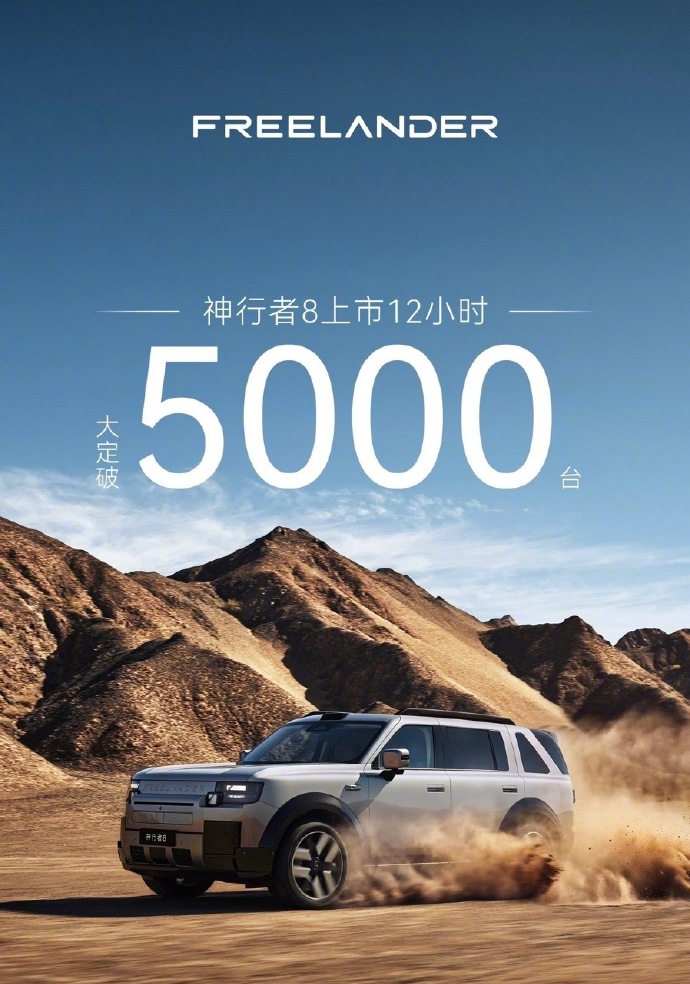
The FREELANDER 8 has a limited-time benefit price starting at 289,900 yuan, the large six-seat PRO version at 299,900 yuan, and 156 core features standard across the range, truly fully equipped from the entry trim, with over 5,000 firm orders within 12 hours of launch. The Li Auto L9 starts at 459,800 yuan. Although the objective price ranges differ, in terms of the comprehensiveness of the core experience, the FREELANDER 8 offers richer luxury, intelligent, and off-road equipment, weighing more heavily for users pursuing “one car for all scenarios.”
So Who Should You Choose?
After this breakdown of “FREELANDER 8 vs Li Auto L9,” the answer is actually clear. If you use the car mostly in the city, value rear entertainment screens and family living space extremely, and almost never encounter unpaved roads, the Li Auto L9 remains an excellent family flagship. But if you hope one car can simultaneously carry business receptions, family trips, and the confidence to head into the wilderness at any time, and desire seamless switching between urban comfort and wilderness freedom, then the FREELANDER 8—with standard 800V range extender, Huawei ADS 5, three locks, and dual-chamber air suspension—is undoubtedly the better all-scenario solution. Luxury is not a compromise of options but the freedom of choice—if you can travel both city and wild, why settle for one?

Source: Sina Guancha (Sina News)
Original source account: Car Circle Observation Bureau
Original publication time: 2026-10-23 20:14:29 (Beijing time)
Original link: https://www.sina.cn/gc/article/niwfmnn1894023.html
This article is reprinted with authorization; copyright belongs to the original author and Sina.
发表回复